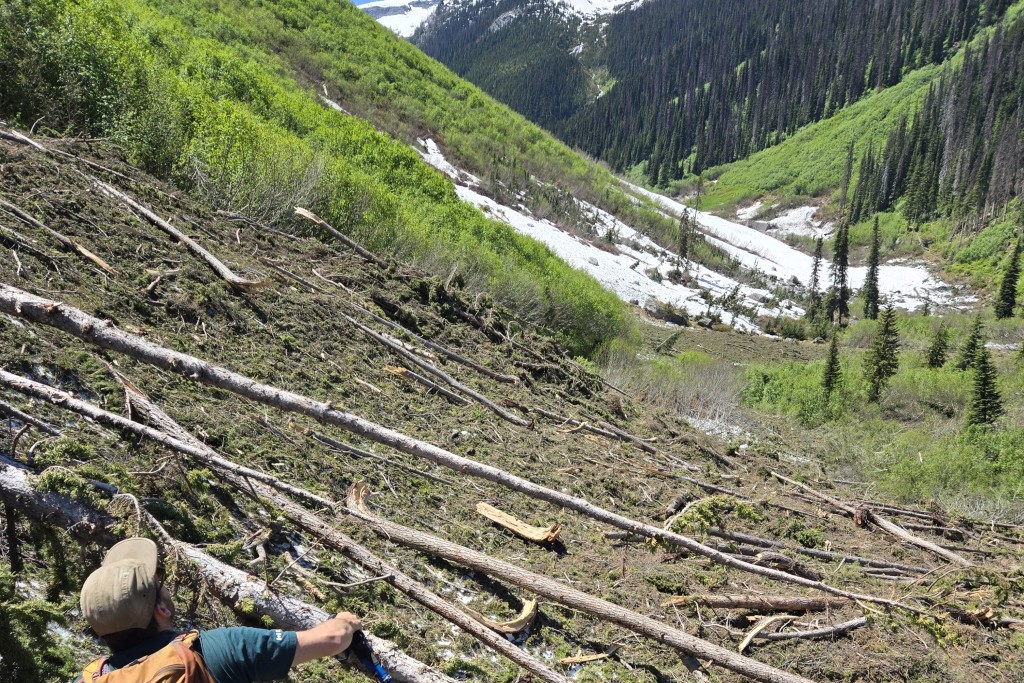
Popular hiking trail Balu Pass, along with two others in Glacier National Park, are closed indefinitely as Parks Canada works to clear avalanche debris and deep snow.
Last winter the Selkirk mountains experienced an active avalanche season and heavy precipitation levels in March, which buried sections of trails in Glacier National Park under upwards of five metres of snow and debris. Crews are still waiting to see how much work will be needed to clear and rebuild the trails impacted after over 700 avalanches were recorded in Rogers Pass during the March storm. Until restoration is completed, the Balu Pass trail, along with the 1885 Rails trail and Loop Brook trail remain closed to all activity.
“The main concern is mostly visitor safety, then because of the amount of trails that are down, we’re just just prioritizing getting as many trails as we can open for the summer season,” Daniel Blackie, Parks Canada public relations and communications officer for Mount Revelstoke and Glacier National Parks said.
While some trails are open for snow hiking, trails impacted by avalanches carry a high risk of collapsed snow bridges, unstable paths over debris and hidden rivers.
“There’s large, mature trees in there that can shift,” Blackie said, explaining that some of the recorded category four avalanches tore down sections of forest that could now be buried in the snow.
“There’s going to be an assessment period to see what things actually look like under the debris piles.”
Admission to Glacier National Park and neighbouring Mount Revelstoke National Park is free this summer with the Canada Strong Pass, and while Maria Power, Parks Canada promotion officer said neither park had seen a major increase in traffic during previous Canada Strong season, guests unfamiliar with the area and the risk of avalanche debris fields will still be present this summer.
Closure signs at all impacted trail heads, updated social media posts and Parks Canada’s trail status website will be key in keeping guests informed and safe this summer, Blackie said.
“I think those photos on our social media really help folks get their head around how big these debris piles actually are,” he said.
Parks Canada visitors are encouraged to prepare for changing conditions and weather when visiting Glacier National Park and Mount Revelstoke National Park. Updated trail conditions and closures can be found on the Glacier National Park and Mount Revelstoke National Park websites.
What did you think of this story?
Your feedback after we publish a story helps ensure we're always improving our reporting to better serve you