
City staff recommend existing short-term rental regulations following public engagement
Council will finalize the short-term rental policy in June with community feedback in mind.

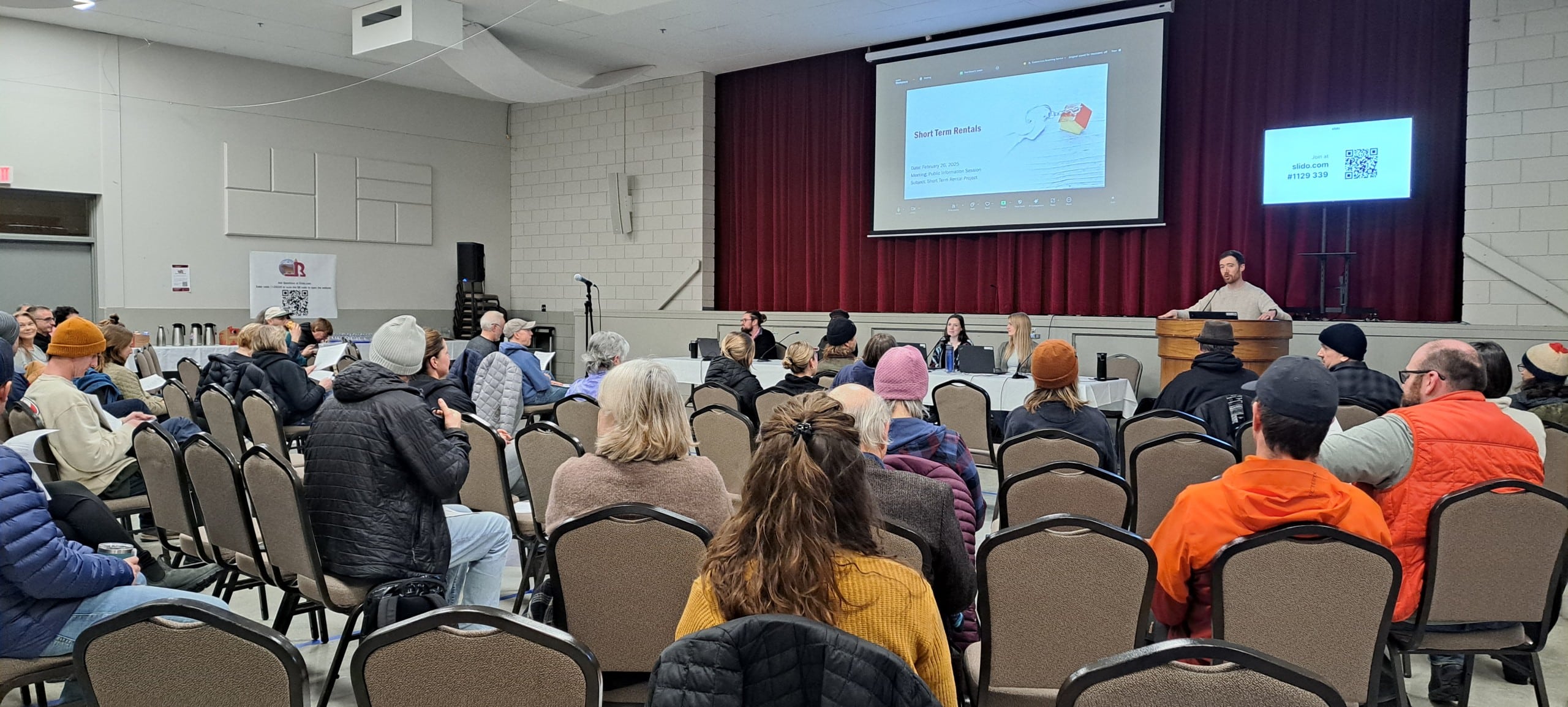
Revelstoke’s solution for short-term rentals might be to stick with the status quo plus a few guardrails, staff told council Tuesday, April 28. The recommendation comes after a year of council meetings, round tables, public information sessions and community feedback.
Staff have been working to develop a “Revelstoke specific” short-term rental strategy following the provincial adoption of Bill 35 in October 2023. This bill allows resort municipalities to incorporate a primary residency requirement for homes used as businesses for short stays and tourism. Following several months of community engagement, staff say opting into the residency requirement isn’t an option.
Instead, the focus has been on whether to restrict short-term rental zoning to specific areas or allow them in all zones or create a larger licensing system that caps how many short-term rentals can operate anywhere in the city.
Now, an economic report and public engagement summary shows Revelstoke might already have the best solution in place. An additional three-strike enforcement rule and advertisement requirements could iron out current wrinkles.
“Some of the feedback we heard extensively throughout the process is that the existing framework is working relatively well,” Paul Simon, director of development services said.
The current system was built off historical decisions specific to Revelstoke’s environment and is tailored to specific neighbourhoods suited for shorter rentals.
Currently, Revelstoke’s potential short-term rental stock sits at 726 total units, 625 as whole home rentals instead of auxiliary units. With roughly 4,260 dwellings in the city, Revelstoke’s short-term rental framework could allow a maximum of 17 per cent, which drops to less than five per cent when potential short-term rental stock in comprehensive development zones such as the resort lands and Mackenzie Village is removed from the equation.
Comprehensive development zones are pockets of developments that operate with specific regulations, offering a response to Revelstoke’s growing tourism rental market for the last 20 years.
“It becomes really tricky to start to unwind those and try and get them into conformance with the rules for standard areas,” Simon explained. Staff instead recommend these zones remain operating as-is with the additional three-strike rule and advertising requirements.
Parking was a main issue brought up during feedback, prompting the requirement for available parking included in advertisements.
Keeping Revelstoke’s current system might also give the city time to see if housing projects, such as the Downie Street affordable housing project, help alleviate the housing shortage.
“We are in a resort town that is dealing with ever-escalating housing challenges,” Simon said. “Short term rentals, rightfully or wrongly, are viewed as potential scapegoats for those issues, but they do have an impact on the neighbourhood.”
The economic report showed different regulation options impact Revelstoke from $2.9 million to $10.3 million annually but did not include the impact of Revelstoke’s current framework. Council was also interested in the potential economic impacts on non-tourism businesses such as construction work building compliant short-term rentals.
Couns. Aaron Orlando and Matt Cherry proposed pushing a decision to a further date for more time to study the economic impact and housing reports created by Deloitte. While staff recommended keeping current regulations, some councillors wanted to see if the policy allowing short-term rentals in all low-density zones could be modified to meet a middle ground.
“I think it would be good if we just had some time to digest a little bit more given that we spent a year doing this,” Orlando said.
Council will have a special council meeting Tuesday, June 16 dedicated to choosing an short-term rental regulation policy.
What did you think of this story?
Your feedback after we publish a story helps ensure we're always improving our reporting to better serve you
Author

Related Articles

Birch and Lace salon offers apprenticeship-style academy for future hair stylists
The skills program aims to keep residents in town and learning in-house as salon founder focuses on accessible education opportunities.

Revelstoke hosts inaugural Indigenous Artisan, Creator and Fashion Gathering
Indigenous creators and artists came from across Canada to celebrate Indigenous Peoples Day Saturday, June 20 and Sunday, June 21.

‘It impacts my whole life’: Residents share concerns with wastewater treatment plant stench
With wastewater treatment plant smells expected to last through the summer during construction, residents want the health impact acknowledged.