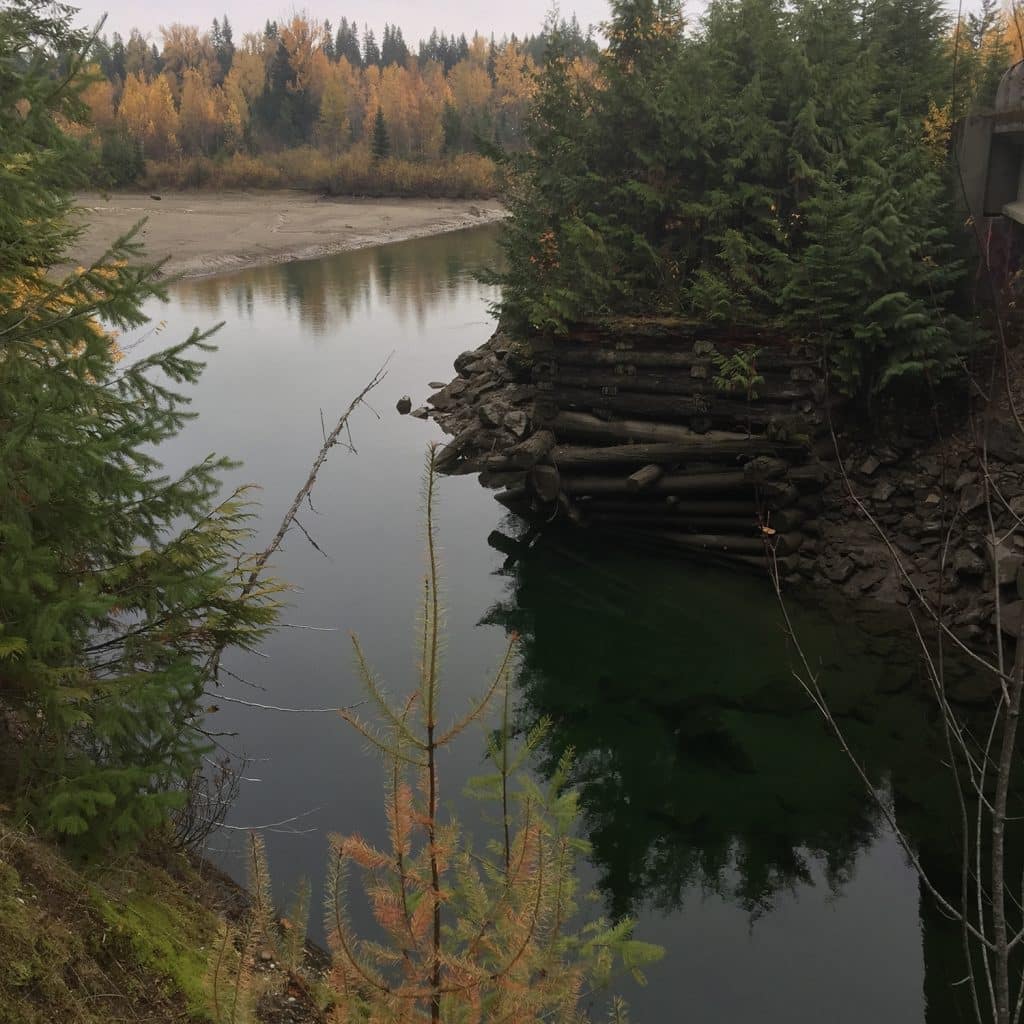
Wildsight Revelstoke is celebrating news from the provincial government that a forested natural area near the confluence of the Jordan River and the Columbia River will be protected from gravel extraction and other industrial uses for the next 10 years.
The news came in a letter dated Jan. 4, 2022, from the Ministry of Forests, Lands, Natural Resource Operations and Rural Development. The letter, which was sent to the City of Revelstoke, grants a “Section 17 Conditional Withdrawal” tenure to the city.
The tenure means the land in question is withdrawn from consideration of industrial development, such as gravel mining, or recreation applications for a period of 10 years.
A city staff report on the Feb. 8, 2022 Revelstoke city council agenda notes that the city’s application for the Section 17 exclusion came after Wildsight Revelstoke wrote to the city on Mar. 5, 2021. The letter asked the city to seek protection of the area, which had been the subject of interest for gravel extraction.

The tenure excepts several disposition uses, including low impact non-mechanized uses, public utilities, or community or institutional purposes.
Wildsight Revelstoke Branch Manager and spokesperson, Aviva Fialkow, said Wildsight was “thrilled” to hear the news.
“Wildsight Revelstoke is grateful to the Ministry of Forests, Lands, Natural Resource Operations and Rural Development for listening to concerned local citizens and recognizing the value in rezoning the Jordan River to prevent industrial resource use and development,” she said.

Fialkow said the area is valued for its ecosystem values. “This biodiverse area contains both forest and riparian ecosystems, offering habitat to vulnerable species like the Great Blue Heron, which is classified under Schedule 1 of the Species at Risk Act.”
Fialkow said the group plans to continue work to preserve the area beyond the 10-year tenure exclusion. “Wildsight looks forward to working with the City of Revelstoke to discuss a shared vision for the Jordan River that balances environmental protection with new opportunities for recreation to ensure that wildlife, wild spaces and our community are healthy and thriving for years to come.”
After considerable debate and controversy over approach, council eventually opted to pursue the Section 17 application in a split vote. See our background story here:
Tense moments as Revelstoke council rejects Jordan River park zoning protection option
In early 2020, plans for a proposed gravel mine by Jake and Jay Construction drew a large crowd to the Revelstoke Community Centre, where most opposed the proposed gravel mine, citing the unique ecological value of the area, which is a forested riparian area between Westside Road and the Jordan River, and also slivers of land on the opposite side of the Jordan River.
Revelstoke residents speak out against gravel pit proposed near Jordan River
Background: Gravel pits in Westside Road area a source of controversy for past decade

There are several active gravel pits in the Westside Road area, and over the years several more have been proposed, some rejected.
There have a handful of public meetings on various gravel pit applications in the past decade, which have engendered considerable local controversy.
Although there are several gravel pits nearby, the application for a gravel pit at the confluence of the two rivers drew more public attention, partly because the area sees regular use by residents and the fact that it is a riparian area. There is a popular hiking trail to the Big Eddy Bluffs on the west side of the river, and on the east side of the river there is an informal forested trail popular for nature walks near town.

The river is also popular for kayaking, featuring waterfalls and rapids further upriver from the area.
Although some gravel pit applications have been rejected for various reasons, this is the first drive to meet much success.
Opposition to previous gravel pits was less organized and was primarily focused on stopping individual applications, for reasons such as visual aesthetics and health concerns over dust, which can be a health hazard, especially in higher concentrations.
Jurisdiction issues between the city and the B.C. government have also factored prominently; the area is in city limits but is owned by the province, similar to several other gravel pit applications in the past decade. The interface between the two government organizations is highly bureaucratic and the reasons for provincial decisions are hard to discern. The province tries to balance competing interests, such as ecological values, the need to provide materials like gravel for construction projects, the need to generate revenue for the province, and the legal rights of those making applications for things like new gravel pits.
By default, the B.C. government communications apparatus generally stonewalls any attempts to find out, meaning few bother trying anymore.
Read an archive of revelstokemountaineer.com’s past stories on the Jordan River area here.
The Feb. 8, 2022 council item is in the “communications” section of the meeting, meaning it is for information, not a decision.
Addition: The word “government” was unintentionally omitted in the second to last paragraph and added about two hours after initial publication.
What did you think of this story?
Your feedback after we publish a story helps ensure we're always improving our reporting to better serve you