
Creating Revelstoke strategies for short-term rentals
Keeping money in Revelstoke in light of international financial stressors top of mind for Feb. 26 attendees.
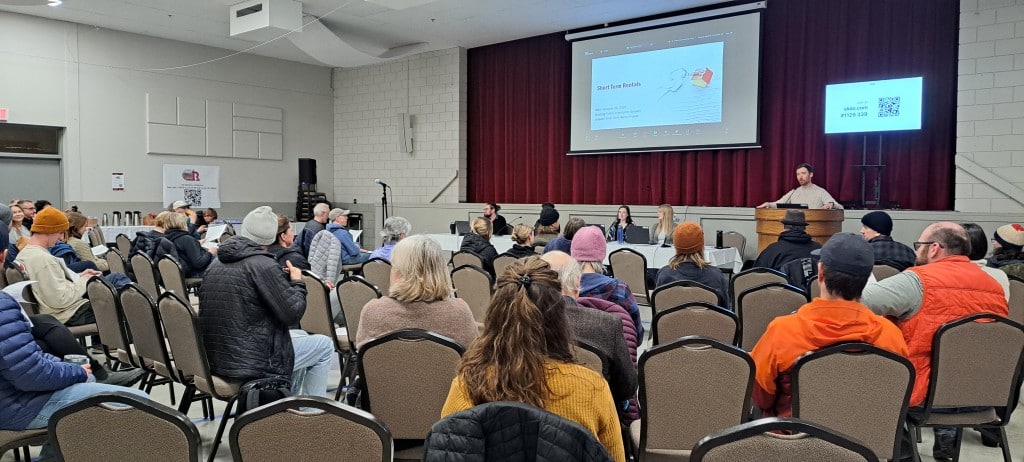
Revelstoke’s short-term rental future was once again the focus of a community meeting Wednesday, Feb. 26 with staff holding a public information session at the Revelstoke Community Centre. Paul Simon, director of development services stressed at the top of the meeting that Revelstoke is still in the early stages of what will be a long process.
“Regulating this type of development is complex,” Simon told an audience of roughly 60 in-person attendees and an online audience. “No municipality has found the one silver bullet to do this.”
Staff are gearing up for eight months of community feedback sessions, public information sessions and a survey gathering information on what Revelstoke wants to see for the future of STRs.
Seeking data for solutions
Municipalities across the province are already publishing the data around provincial regulations for STRs, giving Revelstoke staff a chance to explore ways Revelstoke could navigate different scenarios.
A particular stat shows that restricting STRs, including opting into a permanent residence clause might not be the needed strategy to alleviate large scale housing and rental shortages. Municipalities that were required to implement permanent residence regulations have not always seen an increase in available long term housing and other international data points to STRs possibly not being as large a drain on longer term rental stock as previously thought
“It might not be as great as may appear on the surface,” Simon told the crowd when asked if it was possible to assess the economic impact of a low long-term rental stock.
Permanent residence; to opt-in or to opt-out
The potential for future councils to opt in and out of the permanent residence clause of Bill 35 could mean local businesses navigating the ins and outs of a shifting policy. STRs closing shop due to owners not living in them as a main residence won’t just shift Revelstoke’s STR stock, it could mean a loss for various businesses in town connected to the STR market.
“That’s the worst case scenario,” Caroline Lachapelle, Revelstoke Chamber of Commerce’s executive director told Revelstoke Mountaineer.
Still, Lachapelle is confident city staff will keep that particular challenge in mind as they build out new STR frameworks and potentially pitch to council Revelstoke provincially opting out of the permanent residency clause but building their own local bylaws for the scenario. She highlighted during the STR information session and to Revelstoke Mountaineer that city staff have been proactively communicating at a level previously unseen.
“I think something that the public might not be aware of is the astronomical amount of meetings that the chamber has with the city in private, talking about the pinch points they’ve created and solutions businesses think could work.”
Creating a Revelstoke short-term rental solution
“Revelstoke problems are best solved by Revelstoke solutions,” Coun. Tim Stapenhurst wrote on the Slido site, used to collect questions and comments from in-person and online attendees. As Simon pointed out, previous STR regulations within Revelstoke have been focused on finding the balance best tailored to Revelstoke.
Other residents want the longer term future of Revelstoke to be kept in mind during planning.
“Nobody’s been talking about quality of life. When you’re surrounded by short-term rentals, it changes the neighbourhood, your surroundings, your neighbours. It’s not pleasant,” Carolyn Lorrain, long-term rental landlord said. She mentioned supporting current zoning for Revelstoke’s STRs instead of allowing a blanket allowance throughout the city, letting folks move to areas where they can expect STRs to be.
With international economic threats on the horizon and all levels of governments strategizing how to navigate upcoming tariffs, trade deals and more, some residents want to see STRs focused on creating one more local economic opportunity for Revelstoke. Opinions were divided on whether to use the permanent residence clause to keep ownership local, but a core theme remained the same.
“The hotels that are generally being built in Revelstoke are corporate owned by companies outside of Canada, which means revenue leaving Revelstoke. Short-term rentals are owned by a lot of locals, and we’re seeing that revenue stay in Revestoke,” Emily Revell, owner of Stay Revy Vacation Rentals said.
Residents will have until Monday, March 31 to fill out TalkRevelstoke’s survey gathering input and community solutions for STR regulations in Revelstoke. The survey asks whether participants think Revelstoke has enough current STR stock, whether local residents should be able to participate in Revelstoke’s tourism industry via STR stock and where STRs should be zoned. An economic analysis is scheduled to start in March and a bylaw drafting could start by July before staff present the draft for public input by October. Those interested in keeping track of updates are encouraged to sign up for emails from the city via the TalkRevelstoke page.
What did you think of this story?
Your feedback after we publish a story helps ensure we're always improving our reporting to better serve you
Author
Related Articles

Birch and Lace salon offers apprenticeship-style academy for future hair stylists
The skills program aims to keep residents in town and learning in-house as salon founder focuses on accessible education opportunities.

Revelstoke Mountain Resort provides updates on infrastructure upgrades and partnerships
Resort president Jason Kelder shared planned changes coming to the resort, which include a new warming hut.
Glacier National Park trails remain closed following heavy avalanche season
Balu Pass trail, along with two others are closed indefinitely as Parks Canada staff evaluate how much of the popular trails will need to be rebuilt.