
Revelstoke City Q&A on short-term rental regulations explained
City and residents need to answer core questions before deciding on short-term rental actions, city staff says.
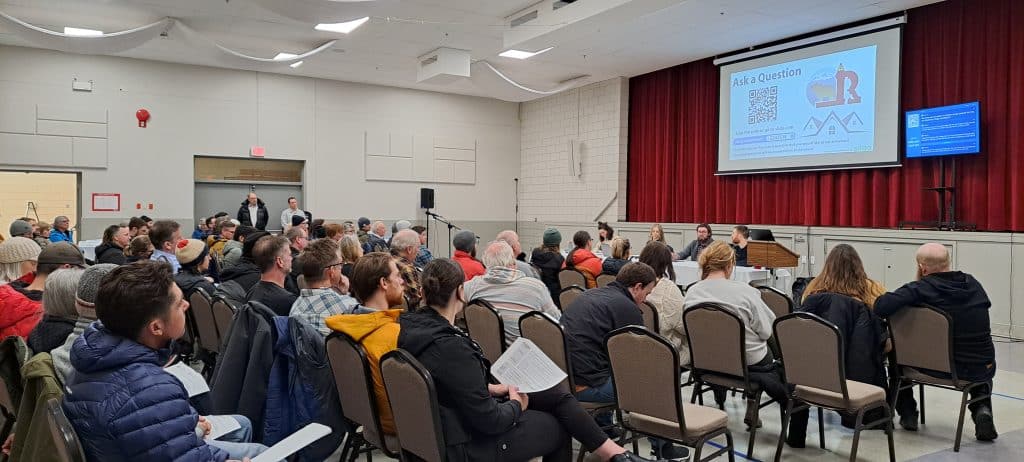
City of Revelstoke staff sat down with a packed hall of over 100 residents and an estimated 300 online viewers during an open house presentation on current short-term rental (STR) regulations. During their presentation, they discussed how residents would be affected by provincial regulations and what things city staff are watching play out in other municipalities.
Here’s what Revelstoke Mountaineer learned.
Revelstoke’s current STR rules
Provincial legislation will be impacting current STR zoning and bylaws in Revelstoke, which are currently designated as a dwelling unit rented out for less than 30 days at a time. Secondary suites, condo units and full single family units all fit under the dwelling unit regulation.
Zoning bylaws throughout the city can affect STR requirements, such as 32 V zoned properties, commonly referred to as “spot zones.” Currently, each of those properties can run as a whole-home STR with 24/7 management not always residing on the property. Revelstoke’s April 2022 full scale STR update expanded those regulations to also involve single detached dwellings within the Revelstoke downtown and Victoria Road commercial zones.
Six comprehensive development (CD) zones are also allowed to operate as whole unit STRs. Currently that includes row houses on Townley Street, the Mackenzie Village project and current housing throughout the Revelstoke Mountain Resort zone. City staff estimate 1,000 to 3,500 potential units could be created within CD zones and 506 are currently in the works, including the Mackenzie Village project.
Those 506 multi-unit dwellings join 154 single-detached dwellings, zoned for whole home STRs or permanent onsite operator STRs, to total roughly 17.5 per cent of Revelstoke’s current housing stock eligible for legal STR operations.
“Quite a substantial amount of short-term rentals within the community are already zoned,” said the city’s senior planner Paul Simon.
Both STR and bed & breakfasts in Revelstoke require a business license to operate. B&Bs are classified as rooms rented out within a primary dwelling for less than 30 days. All standard residential zones allow for B&B operations within single-detached dwellings.
Where Bill 35 changes things
Legal non-conforming STRs within the city (properties grandfathered in as Revelstoke worked to lay out STR frameworks) will no longer be protected come May 2024. While Revelstoke has few legal non-conforming properties that will be affected by the May change, staff are worried what provincial changes to legal nonconformity could mean for future bylaw changes.
“If we change our regulations to create properties that are now no longer in compliance what does that look like?” Simon said. “They would no longer be protected as grandfathered properties. We have to think about this really carefully.”
The large focus of how Bill 35 could change Revelstoke’s STR regulations remained on the principal residence requirement, a part of the legislation Revelstoke and 13 other resort municipalities are exempt from but can choose to opt-in to.
“We can use this, if we opted in, as a floor for our local regulations,” Simon said. “We can build more strict regulations on top of it. But we cannot build more lenient regulations.”
An example of where Revelstoke’s current policy is stricter than provincial and would potentially need revisiting is the length defined as short-term. Bill 35 classifies short-term as being a stay of up to 90 consecutive days while Revelstoke limits it to 30 days.
Opting into the principal residency requirement would mean Revelstoke’s 154 single-detached dwellings currently zoned for whole home STRs would then require an owner claim it as a principal residence for the majority of the year. It would also open up potential STR stock as the province’s Bill 44 shifts future resident zoning to allow secondary units on properties.
Bill 44 would classify a primary house on the property as the primary residence, allowing for a legal suite and carriage house on the property to be rented on a short-term basis while the property owner lives full time in the main house.
“If we opted in, we’d have to consider how to then tweak our existing zoning rules if we don’t want to expand short-term rentals with that rule throughout the whole community,” Simon said.
Where does provincial support step in?
Attendees in person and on the Sli.do app asked what legal ramifications the city could face for properties originally promised CD zoning regulations.
“Discussions with the province have gone along the lines of, ‘if people want to sue you, they’re suing you based on provincial legislation. Which means they sue us,’” Simon said. “Which isn’t how it works, in practice. The city gets dragged into this all the time.”
Potential legal issues would be a drain on staff resources and time, taking away from current and future community projects, Simon said. It was another argument for staff, council and residents to take time in deciding what routes to take and how to build on provincial regulations.
“We don’t want to go that route [of being sued]. That’s why we want to be thoughtful, methodical about how we go about this.”
The opportunity to opt in does come with the opportunity to opt out, a point residents voiced as potential confusion if future councils voted years down the road to opt out and then back in.
“When councils shift and new people come to the table, there’s always the risk of that,” city staff member Adrienne Comars said. “If this is opt in, opt out each year there could be a change in the future. But maybe that’s not necessarily a bad thing.”
At the end of the day, Simon repeated, future STR regulations within Revelstoke and the potential for opting into the primary residency requirement needed to answer one key question.
“What are we trying to achieve? Are we trying to restrict short-term rental at all cost in preservation of long-term rental accommodations? Or, are we trying to use short-term rentals as a way for the locals of Revelstoke to participate in our tourism economy?”
Questions not answered during the presentation would be answered online and through future city communications.

What did you think of this story?
Your feedback after we publish a story helps ensure we're always improving our reporting to better serve you
Author
Related Articles

Birch and Lace salon offers apprenticeship-style academy for future hair stylists
The skills program aims to keep residents in town and learning in-house as salon founder focuses on accessible education opportunities.

Revelstoke Mountain Resort provides updates on infrastructure upgrades and partnerships
Resort president Jason Kelder shared planned changes coming to the resort, which include a new warming hut.

Glacier National Park trails remain closed following heavy avalanche season
Balu Pass trail, along with two others are closed indefinitely as Parks Canada staff evaluate how much of the popular trails will need to be rebuilt.