
Video & audio interview: Mountain caribou penning project has successes and challenges
The Revelstoke Caribou Rearing in the Wild project captured 18 more mountain caribou cows in late March and early April for the second season of their maternity penning project.
The program sees pregnant mountain caribou cows give birth in a protective pen located on the west side of Lake Revelstoke. The pen shelters the young calves from predators during their first few months when predation rates are high.
Revelstoke Caribou Rearing in the Wild executive director Kelsey Furk spoke with the Revelstoke Mountaineer on April 8 about the successes and challenges the project has faced in its first year.
The program had great technical successes. The capture went well and the pen worked as it was supposed to in the first year, keeping predators out. All of the cows and calves returned to the wild and reintegrated with wild herds.
But the challenges started there. The survival rate wasn’t what was expected, and they had difficulty with tracking collars on the calves.
(Listen to our interview with Furk by clicking the play button on the SoundCloud interview below. The story continues below.)
Two of the nine caribou calves released into the wild last summer as part of the Revelstoke Caribou Rearing in the Wild (RCRW) maternity penning project have survived as of March this year.
The result is a disappointment to organizers of the maternity penning project. In an interview with the Revelstoke Mountaineer, Furk explained her views on the mixed results.
“There is no question that I am disappointed with the fact that we didn’t have more calves survive until March,” Furk said. “In terms of all of the things that we have had control over — in terms of managing the pen, the capture, the calving and making sure that predators were excluded from the area, and the great community involvement we’ve had … from that perspective it’s been a great success.”
She said she was “cautiously optimistic” that the high level of survival amongst adults is an indicator they are having a positive effect on adult survival, which could translate to increased calf survival in the future.
An April 2 report on the 2014/15 program summarized RCRW society’s work in the first year of the program.
“While the RCRW team had hoped for a higher survival rate for pen-born calves we understand the risks that are associated with such a project,” states the report.
The project had numerous successes in its first year. All of the 10 cows captured survived, as did all nine calves who were born and raised in the pen until their July, 2014 release.
The pen was effective in keeping predators out. Although bears, cougars, lynx, coyotes, wolves and wolverine were seen in the vicinity, none were destroyed. (One wolverine did get a shock when trying to climb the pen’s electric fence.)
Here’s video from the 2015 caribou cow capture. Story continues below.
caribou capture 2015 from FD Productions on Vimeo.
Of the nine calves released, three died before winter. One was killed by wolves. The team had some difficulty with the expandable collars on the calves, leading to difficulty tracking the animals and their cause of death. By March, six of the calves had left their mothers’ side and are presumed dead, but the cause of their deaths is unknown.
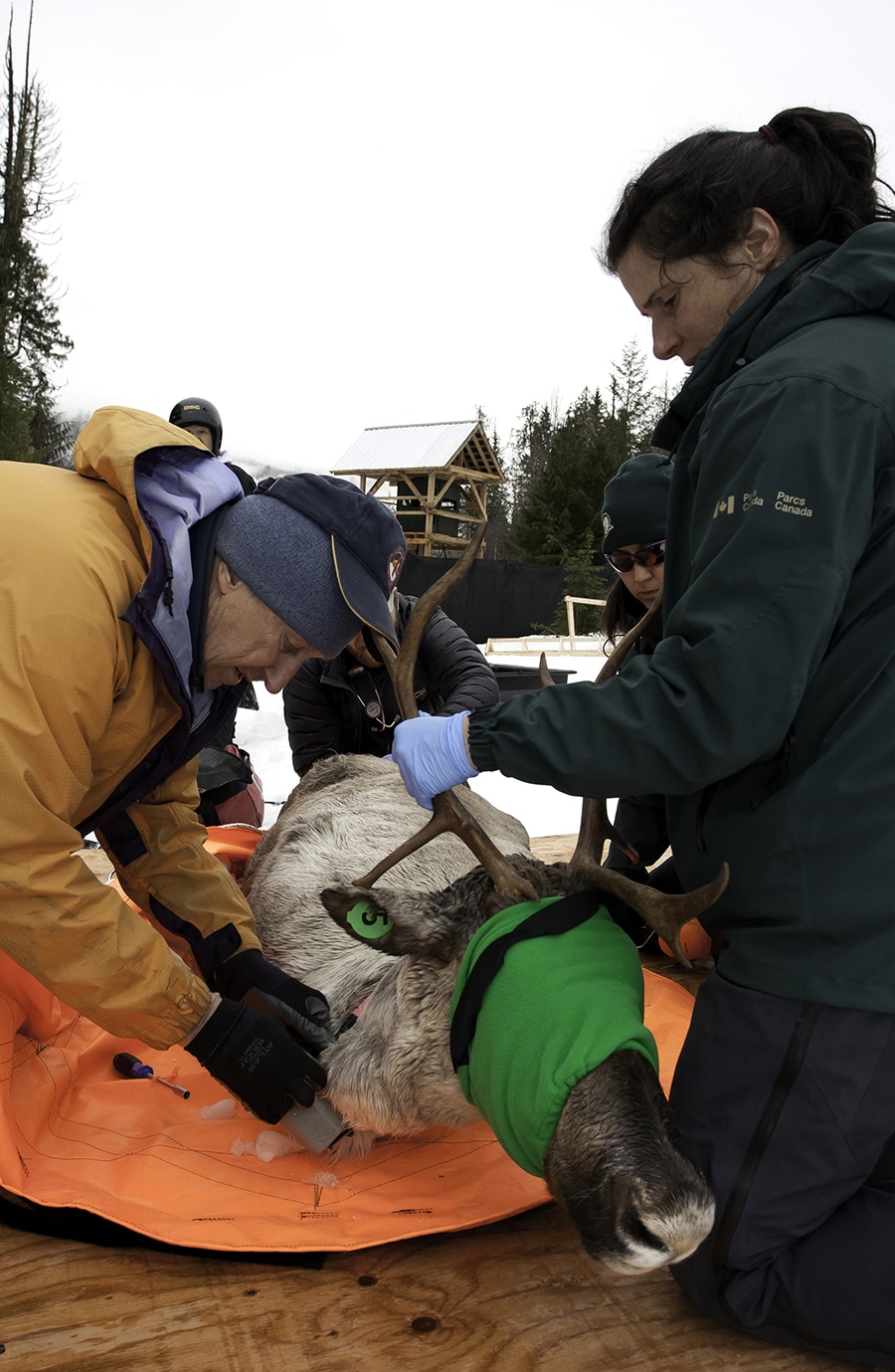
Parks Canada’s Sarah Boyle and Tawyna Hewitt work with RCRW’s John Flaa on a mother caribou in the protective maternity pen. Photo: Rob Buchanan/Revelstoke Caribou Rearing in the WIld
RCRW society notes that unusual weather this winter was a factor. It was a warmer winter with less snowfall than average. In the winter, mountain caribou feed on lichen that hangs from trees in the sub-alpine, and lower snow levels makes it more difficult to reach the lichen.
The reduced snowpack influenced caribou behaviour by increasing the amount of time spent in early winter low elevation habitat,” the report states. “Usually, southern mountain caribou migrate to and remain in the sub-alpine in late winter.”
In her interview Furk notes one of the big successes was unifying the community behind the project. Dozens of individuals, organizations and other groups got involved.
The report on findings from the first year of the program contains more detailed information and can be found here.
What did you think of this story?
Your feedback after we publish a story helps ensure we're always improving our reporting to better serve you
Related Articles
Wastewater treatment plant upgrades set to future-proof facility for 2 decades
Plans to include Big Eddy residents and businesses into the updated facility still in the early stages, city director of engineering says.
Revelstoke granted $200,000 to rework development guidelines
Clarifying building requirements is key in speeding up development approvals, director of development services says.
More childcare spaces needed as families face estimated $35,000 income impact annually
Revelstoke Child Care Society still has over 160 families waitlisted as plans to expand into Okanagan College building take shape.