
The untapped power of the hot springs
By Dr. R. K. Pearce
This article first appeared in print in Revelstoke Mountaineer Magazine’s June 2021 issue. Read the entire e-edition here:
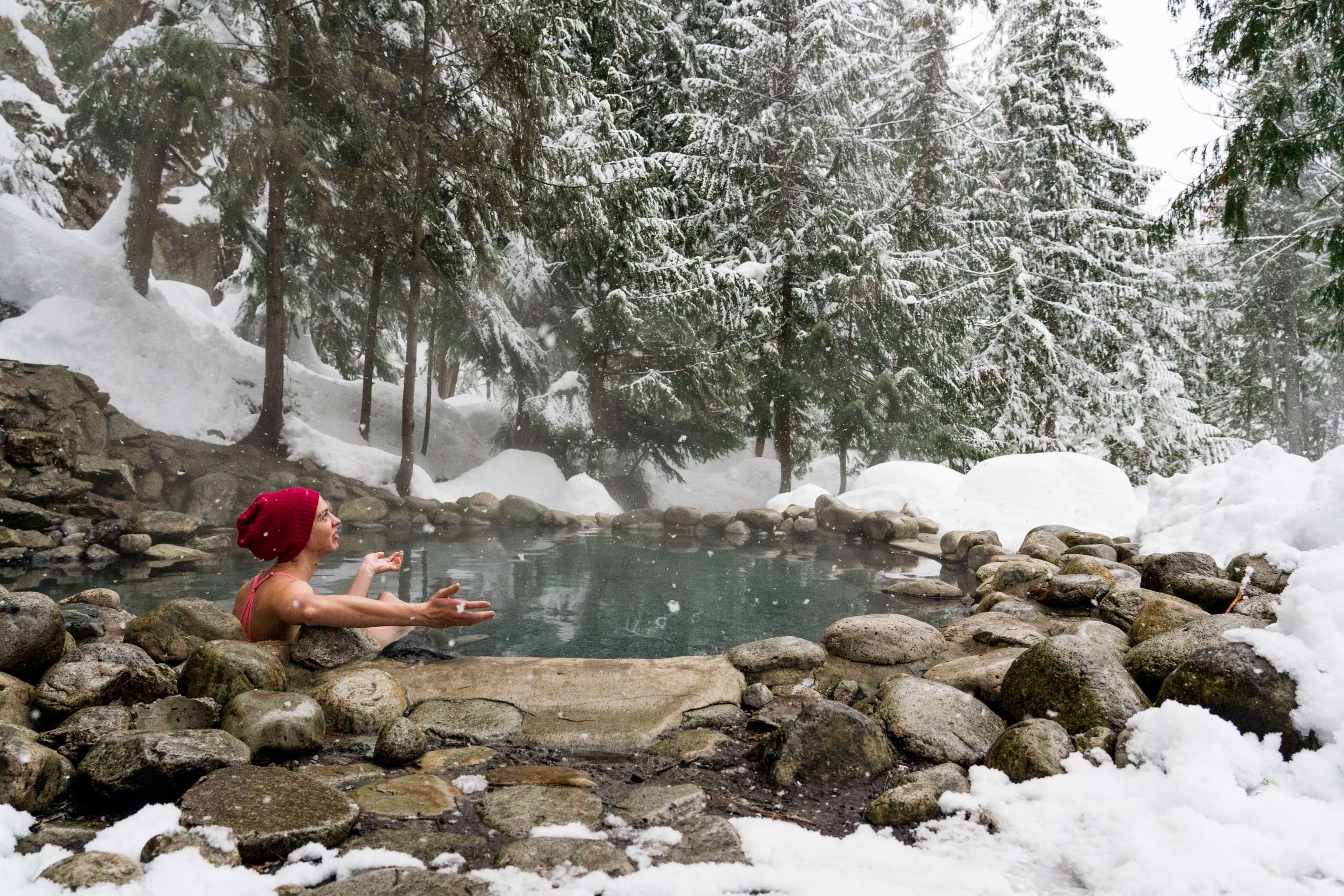
Amongst all the natural wonders that surround Revelstoke, the hot springs that string along the eastern banks of Upper Arrow Lake are a particularly magical blessing. While many of us have delved into the calming and curative waters of Halcyon, Nakusp, St. Leon’s or Halfway for a relaxed excursion out of town, it is not always realized that these pools are connected to a vast energy resource that exists beneath our feet.
Exploring the science behind hot springs
Geothermal, or ‘Earth heat’, energy can be harnessed in many forms, such as small-scale domestic heat systems, to industrial-scale electricity production plants. Geothermal power is a constant, renewable and clean energy resource, which can offset significant CO2 and particulate matter emissions annually output by fossil fuels; however, Canada has yet to tap into its abundant reservoirs of this renewable power. One obstacle to the momentum of Canada’s emerging geothermal industry is the abstract concept of this energy source. Unlike wind and solar, geothermal heat is not something we often experience up here above ground; therefore, we remain blind to its existence and potential. Luckily, the Upper Arrow Lake hot springs in Revelstoke’s backyard provide us the chance to touch, even bask in the Earth’s hidden power.
The main components that create a hot spring are (surprise, surprise), heat and water. In most cases, the thermal energy that heats the springs is supplied by radiogenic heat, which is the heat emitted by the decay of radioactive elements that exist within the Earth’s interior and radiates towards the surface. The second component, water, is typically sourced from rain and precipitation, or meteoric water, as well as remnant waters from ancient oceans that exist deep within the crust. These waters circulate deep underground along networks of fractures, scrubbing minerals from their surrounding rocks, which filter to the surface and collect as hot aquifers underground. When the water from these aquifers finds routes to the surface, they emerge as mineral-rich hot springs.
Take the Upper Arrow Lake springs for example. The origin of the St. Leon’s, Halcyon, Nakusp and Halfway hot springs is intimately linked to the history of the Selkirks and their neighboring mountain ranges, which are geologically grouped as the Omineca Crystalline Belt. As this mountain belt rose above sea level, deep fractures penetrated the crust, which now facilitated the circulation of geothermal fluids within the roots of the mountains. These circulating waters collect in a 90–95oC aquifer, approximately three kilometres beneath Upper Arrow Lake. The aquifer replenishes the hot springs at the surface, which emerge from the ground at 48–50oC, and are rich in calcium, sodium, lithium and sulfur.
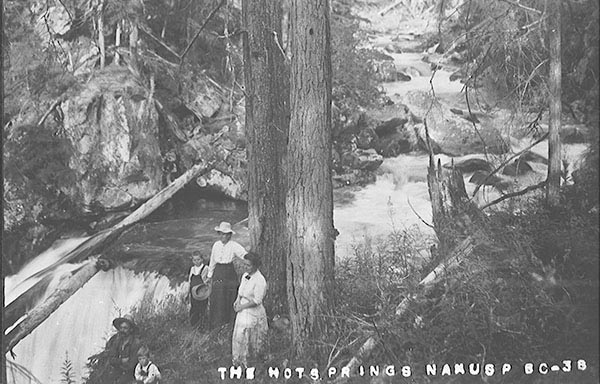
A visit to Nakusp Hot Springs. Photo: Courtesy of Halcyon Hot Springs
Looking back on local geothermic history
Throughout history, it has been observed that these mineralized waters can remedy various health conditions. The Halcyon hot spring site, whose location and health benefits have been known by the Sinixt and Ktunaxa First Nations for centuries prior to European arrival, was converted into a sanatorium after it was sold as Crown land in the 1890s. The health benefits of the sanatorium reached international acclaim for purifying the blood (lithium is now known to be a powerful antioxidant), as well as curing ailments such as rheumatism and arthritis, and Halcyon’s waters were bottled and exported as far as London. The Nakusp hot springs developed in a similar time frame, and similarly advertised the water’s remediating properties; however, it maintained public ownership throughout its commercialization, and remains community operated to date. Comparably, the St. Leon hot spring was used to supply hot water to a nearby hotel that originally accommodated lumberjacks and miners in the area, until it went bankrupt during WWI, burned down in the 1960s and was eventually flooded by the damming of Upper Arrow Lake.
Our uses of geothermal resources have rapidly evolved since the early 1900s. Not only can entire neighbourhoods and agricultural areas be heated with geothermal waters, but this resource can now be used to supply constant, renewable and clean electricity. Geothermal power plants operate by channeling underground geothermal waters via a well to a facility at the surface, which contains a generator and a turbine. As the hot water ascends, it is converted to steam with the loss of pressure, which spins the turbine to generate electricity, and the fluids are then re-injected into the geothermal reservoirs. While there are some variations to the mechanism used in geothermal power plants, the principle of energy production is always the same.
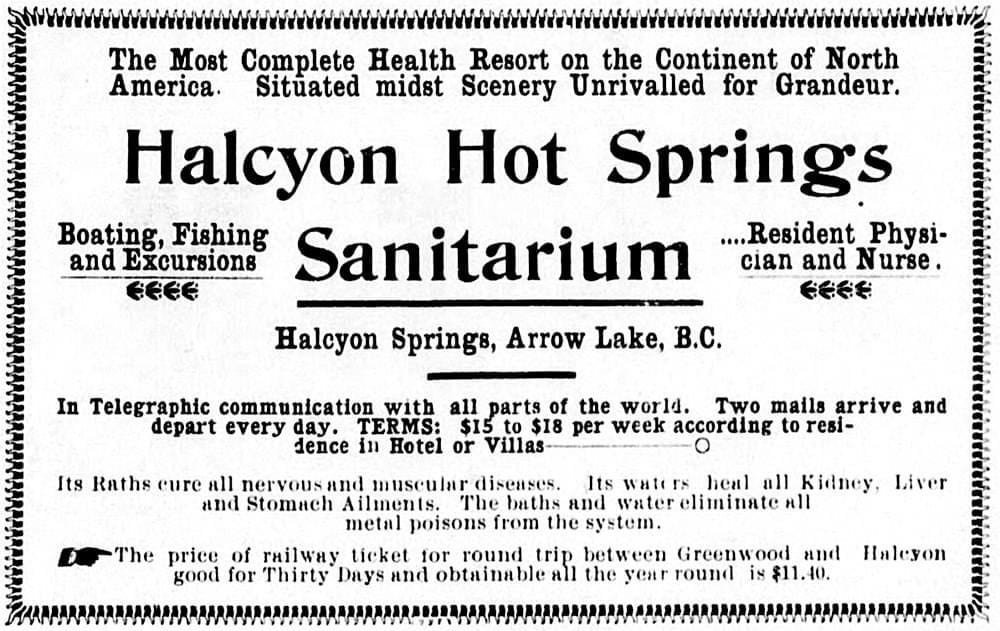
A historical ad for the Halcyon Hot Springs Sanitarium. Photo: Courtesy Halcyon Hot Springs
Understanding the potential of geothermal energy
Iceland is the pioneer of capitalizing on the use of this resource, as it is a volcanically active island with an abundance of geothermal reservoirs, which supplies 90 per cent of the country’s hot water and heating, and 62 per cent of their energy needs. Some of the other global leaders of geothermal energy usage include Indonesia, Turkey, New Zealand and the Philippines. The U.S.A, however, is the global leader in geothermal electricity generation in the world, with a capacity of 3,700 megawatts (one mega-watt equals the power required by approximately 1,000 homes), the majority of which is produced in the western states, such as California, Nevada, Alaska and Idaho. The mountain ranges that host these geothermal reservoirs are directly connected to Canada’s western provinces, where we could certainly emulate the progress that has been made in the U.S.
There are approximately 150 hot springs in Canada that could feasibly be used to generate 5,000 megawatts of geothermal electricity, with the hottest and most viable resources located in B.C. However, we currently produce none. Some of the major barriers to the emergence of our geothermal industry include high upfront costs of exploration drilling and power plant construction with a slow return on investment, a lack of policy and regulation for geothermal products, and a tangle of provincial power monopolies and permitting systems. Nevertheless, the efforts to dismantle archaic energy grid legislation by advocates of Canada’s nascent geothermal industry have been successful, as several geothermal projects are underway in British Columbia, Alberta and Saskatchewan that will initiate our nation’s use of this clean energy resource.
There is, however, another way in which we can capitalize as individuals on geothermal energy. We can use the Earth to supply heat to our homes in the winter, and to cool them in the summer, using a geothermal heat pump system, commonly referred to as geoexchange. These systems are over five times more energy efficient than propane, natural gas or electric heating/air-conditioning systems, and can reduce your home’s carbon footprint by around 50 per cent. There are about 20 geothermal systems in operation in Revelstoke, some that have been constructed with new builds, others as retrofits to existing homes. I had the chance to discuss both scenarios with a couple of Revelstokians who opted for geothermal.
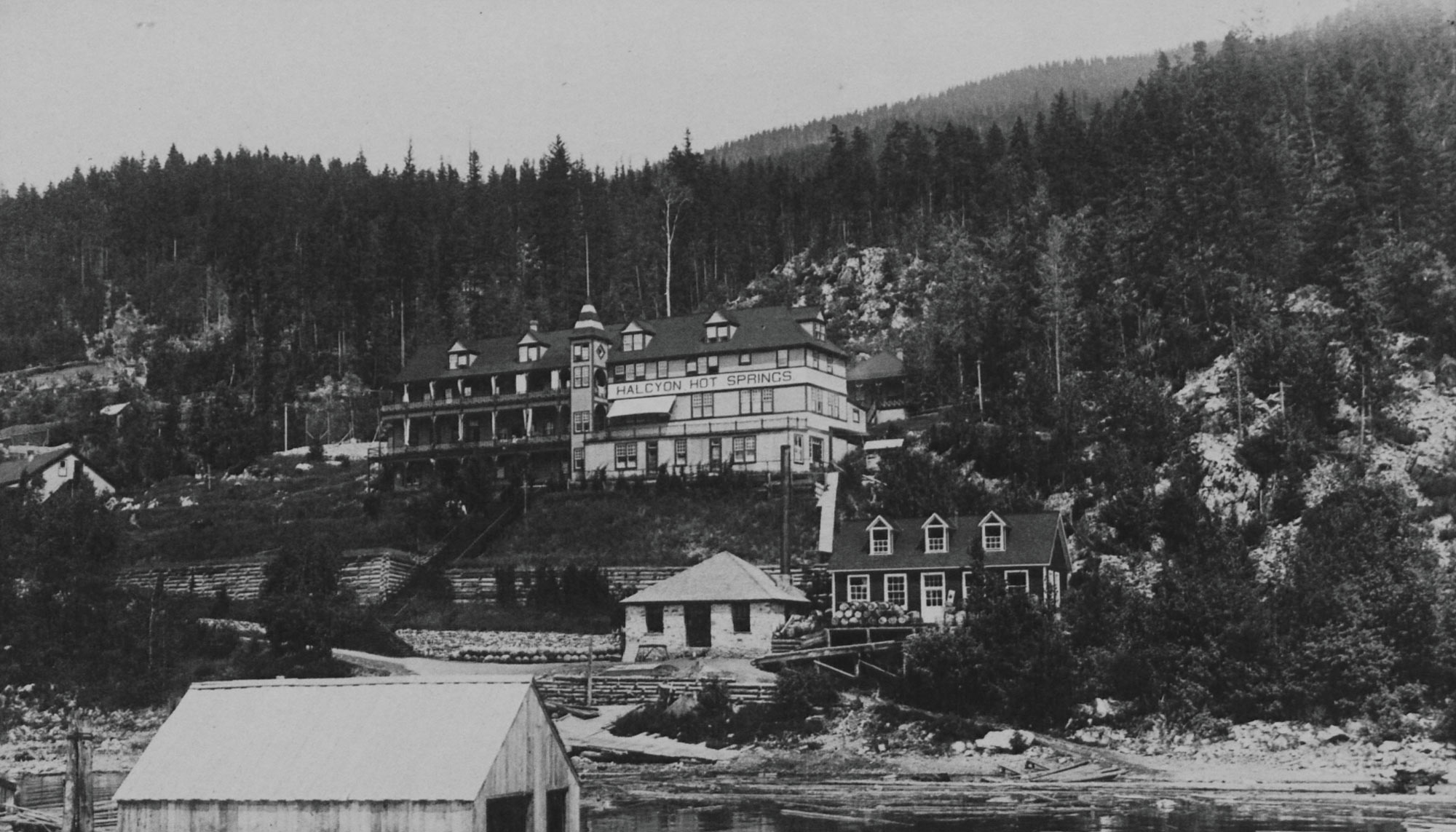
A historic photo of the original Halcyon Hot Spring, which was destroyed in a fire. Photo: Courtesy Halcyon Hot Spring
Ask an expert: Q&A with Mas Matsushita
Mas Matsushita, an engineering-technologist who worked for CP Rail on twin tracking the Rogers Pass and for BC Hydro on the Mica and Revelstoke dams, provided a very thorough insight into the geothermal system that was installed during the construction of his home in Southside in 2009.
Revelstoke Mountaineer (RM): “Can you tell us a bit about the layout of your residence’s geothermal system?”
Mas Matsushita (MM): “The geo-heat exchange unit replaces the conventional heating system furnace inside our home is connected to a forced-air duct system and to wells that collect/expel the heat in the ground. We have 12 vertically oriented wells in our backyard in a grid configuration. Each is about 55 metres deep, with three meters of spacing between them.”
RM: “Sounds like you would need quite a lot of yard space to accommodate the wells”
MM: “You need that much spacing so that one well isn’t ‘stealing’ heat from another. Also, our wells are relatively shallow, but if you drilled deeper you wouldn’t need as many”
I had the chance to compare this with a retro-fit scenario with Ben Wilkey, a Revelstoke based helicopter pilot with a BA in science in physics, who converted the oil-furnace system to geothermal in his 1906 heritage home in downtown Revelstoke in 2007.
Ben Wilkey (BW): “We have four wells that are about 76 meters deep, which fits fine within the yard in our downtown lot”
RM: “And how did the retro-fit work?”
BW: “We had to replace the original air-ducts on the main floor with wider ones for the geothermal system, but this was a relatively simple process considering the other renovations that needed to take place. Now all our heating and cooling, as well as 75% of the heat for our water tank, is supplied by geothermal, which we haven’t regretted once in 15 years.”
RM: “Which brings us to the burning question. How has your financial investment in geothermal paid off?”
BW: “All in, the installation was about $25,000; however, this was subsidized by a $5,000 rebate that was part of a federal incentive plan. It took about 12 years to pay off the remaining $20,000 through energy savings”
When I asked Mas Matsushita a similar question, he responded:
MM: “The system was about $37,000 after the $5,000 rebate, including the drilling, ducts, and the geothermal unit. A conventional propane or electrical air-forced system is around $10,000, however our energy bills are significantly cheaper than these classical heating methods. Annually, we pay about $700 for heating/cooling energy, whereas energy bills are about $3,000 annually for propane or electrical systems. So it took about 10 years to break even for the geothermal system, which was worth the investment for us.”
Both Mas and Ben used Okanagan Geothermal Ltd., which is based in Enderby, and have both been very satisfied with their conversion to geothermal. These systems, which have gained considerable popularity in the US and continental Europe, have a lot of potential for Canada, especially in northern and remote communities that rely on diesel generators for heat. About 65 per cent of Canada’s carbon emissions come from energy expended on heating and cooling purposes, therefore geothermal could seriously negate this value. Unfortunately, the tax rebate is no longer available across all provinces. Overall, geothermal energy is a versatile renewable resource that will have a significant part to play in our renewable revolution, from electricity production to heat supply, store excess heat, as well as mineral resource extraction. We have the technology, we just need to get there.
~
K. Pearce (Ph.D) is a geophysicist who specializes in geothermal resource location, who has studied geothermal systems in Chile, Japan and BC. She has also worked closely with Canada’s leading geothermal advocacy group, CanGEA, and will continue to contribute to BC’s geothermal industry through research projects based out of Simon Fraser University.
What did you think of this story?
Your feedback after we publish a story helps ensure we're always improving our reporting to better serve you
Related Articles
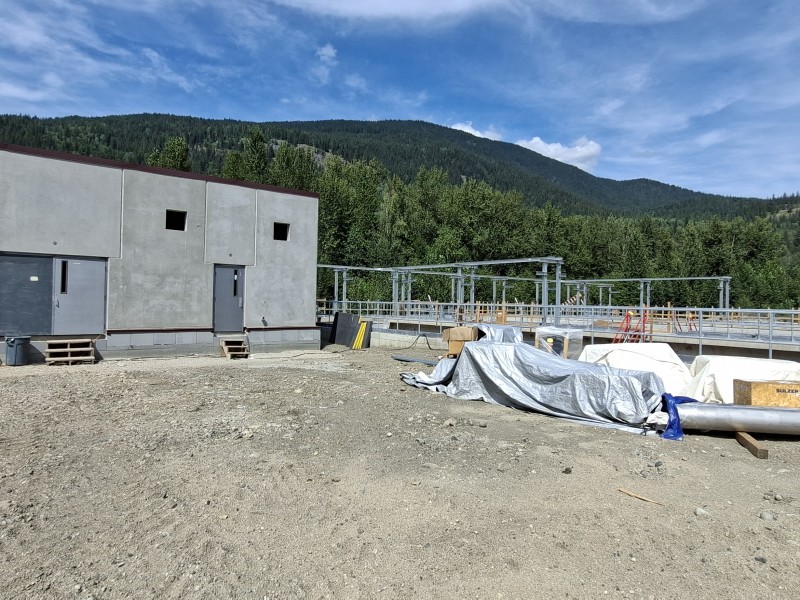
Wastewater treatment plant upgrades set to future-proof facility for 2 decades
Plans to include Big Eddy residents and businesses into the updated facility still in the early stages, city director of engineering says.
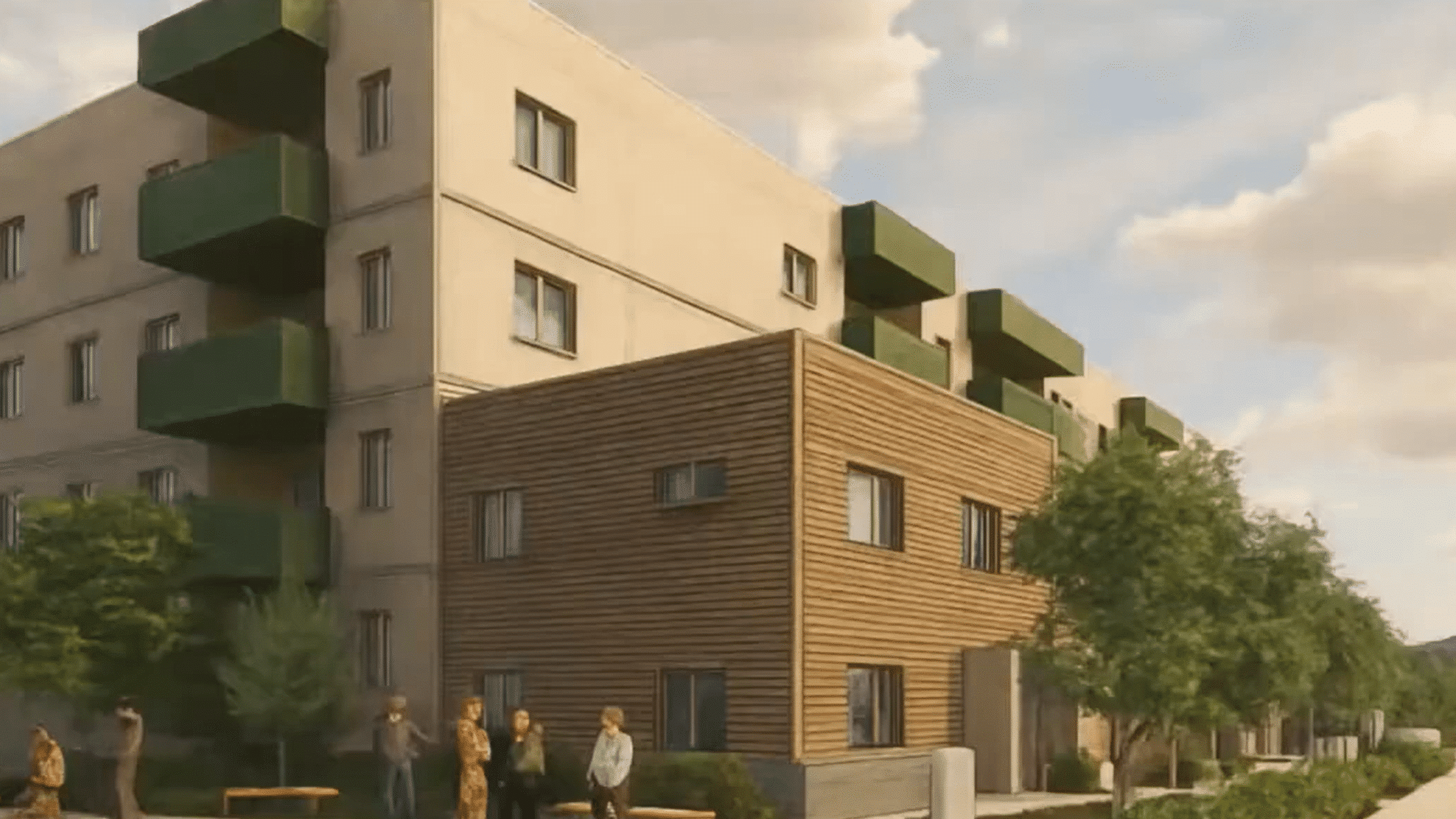
Revelstoke granted $200,000 to rework development guidelines
Clarifying building requirements is key in speeding up development approvals, director of development services says.

More childcare spaces needed as families face estimated $35,000 income impact annually
Revelstoke Child Care Society still has over 160 families waitlisted as plans to expand into Okanagan College building take shape.