
The case of the e-bike: Are Revelstoke seniors pedaling towards a transportation future?
‘When we replace short, single-person vehicle trips with our own human power, sometimes aided by a bit of stored hydro power in the form of an e-bike battery, we can collectively have these trips add up and make a difference. What these seniors have shown me is that we making this difference might just be fun and convenient, too.’
This story first appeared in print in the Winter 2020 issue of Revelstoke Mountaineer Magazine. Read the e-edition here:
Story by Nikki Lussier, North Columbia Environmental Society
Unlikely snowflakes had already foreshadowed an early winter in Revelstoke by the time I met a group of seasoned cyclists. They were undaunted by the weather, and it wasn’t long before I realized we have much to learn from their collective wisdom.
Claudette Kendel, a retired teacher, has kept active for years. In June, when her knees began to trouble her, she set off in search of a new set of wheels, which have since taken her 4,000 kilometres. Though she uses it mostly for exercise and recreation, she’s the first to admit that she’s swapped out her regular car rides for e-bike jaunts — at least two or three per week she reckons.
The number of times we opt for biking over driving makes a difference. May 2019’s Bike to Work Week saw 15,571 kilometres logged in Revelstoke alone. This is the equivalent of riding to Costa Rica and back. If those same trips were made by vehicle, roughly four tonnes of carbon dioxide would have resulted from the process.

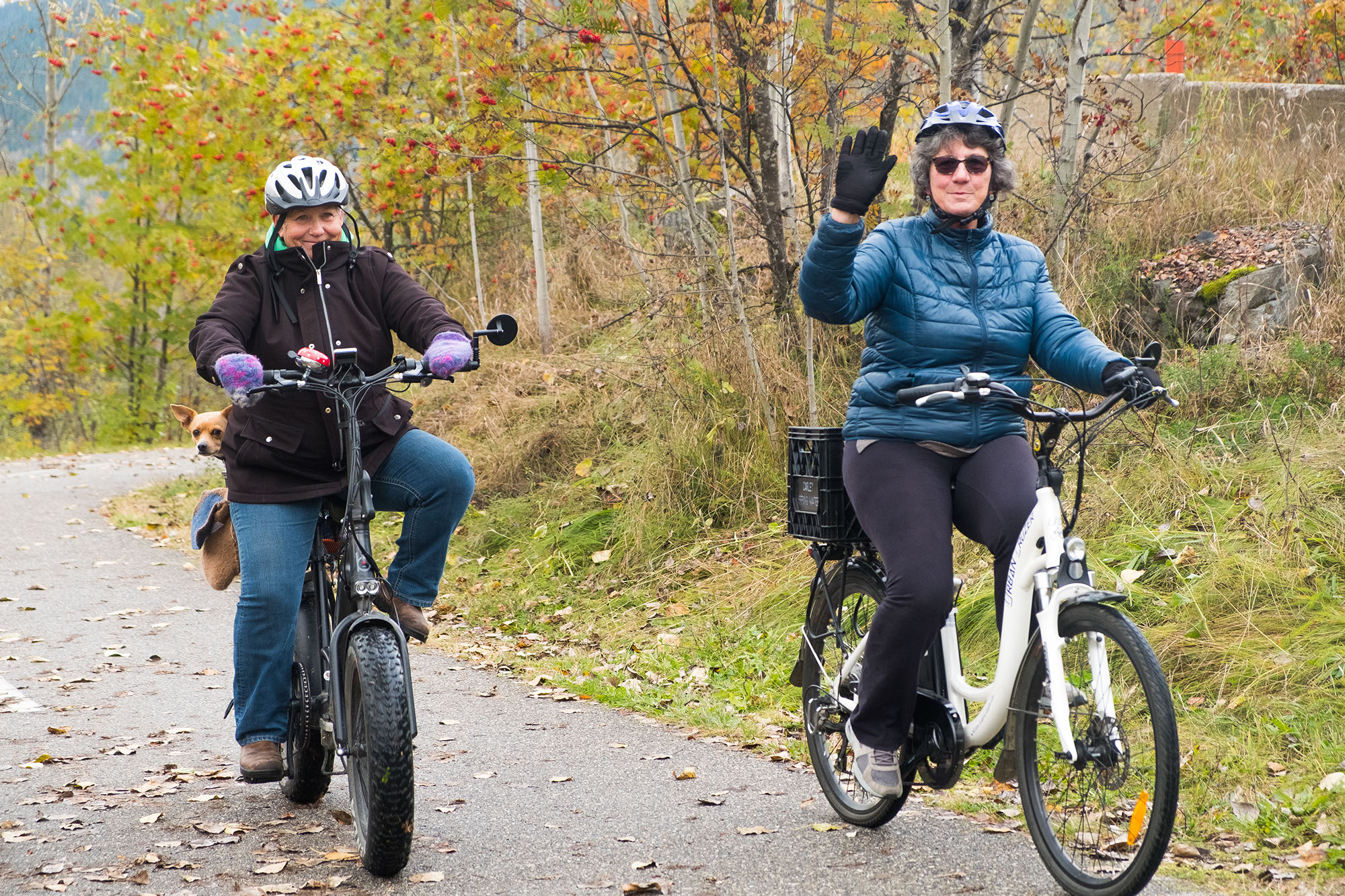
A Revelstoke e-bike adventure group enjoys a fall ride by the Columbia river. Photo by: Nolan Gale.
In Canada, transportation accounts for 24 per cent of climate polluting emissions, second only to the oil and gas industry, according to the David Suzuki Foundation. With vehicles accounting for such an enormous component of our society’s environmental footprint, why are we still driving our cars, rather than walking or biking?
While that’s ideal for some, it’s unfair to say that everyone has an interest in walking or biking, or that everyone has the proper level of physical fitness needed for the task. That’s where e-bikes come in, a mode of transportation literally designed to bridge those barriers. Indeed, they offer convenient mobility with an environmental footprint that is a fraction of the internal combustion engine’s impact.
Nancy Parrott and her sidekick, Peanut, a Jack Russell-Chihuahua cross, have been riding an e-bike for the last three years. In the summer she rarely uses her vehicle and runs errands solely using her e-bike. Just the other day she bought groceries, picked up her mail, stopped at the salon, and voted — all on two wheels. Aside from its health and environmental benefits, Nancy is quick to point out that cycling is in fact more convenient. Using her bike is often quicker than using her vehicle for short trips, and she never has to worry about finding a parking spot.

Nancy Parrott’s Jack Russell-Chihuahua cross, Peanut, enjoys the bike rides. Photo by: Nolan Gale.
Peter Walker, author of How Cycling Can Save the World, raves about the bicycle being one of the most elegant and lasting inventions in history. Additionally, its benefits are proving to be even more pertinent than before: it’s weaning us off our dependence on fossil fuels, relieving traffic congestion, reducing pollution, and helping stem the growing public health crisis of inactive living. Biking is meditative, and being outside connects us to nature. Walker mentions that cycling is safer than people think with the net health benefits outweighing the risks by nearly 10 times.
The physical and mental health advantages of e-bikes are not lost on another group of local retirees. Mieke Blommestein, Sharon Kelley, and Jane MacDonald meet daily for bike rides of 20 kilometres or more. Blommestein mentions that with COVID, this form of transportation has opened the door to another opportunity for socializing, exercising, and spending time outdoors. Set up with panniers and a basket, she runs all her errands with her e-bike. She lives in Arrow Heights, yet she can be downtown within minutes.
Arrow Heights, Columbia Park, Big Eddy — they are all within that ‘sweet spot’ distance to downtown with a variety of viable alternatives for the commute. When we replace short, single-person vehicle trips with our own human power, sometimes aided by a bit of stored hydro power in the form of an e-bike battery, we can collectively have these trips add up and make a difference. What these seniors have shown me is that we making this difference might just be fun and convenient, too.
What did you think of this story?
Your feedback after we publish a story helps ensure we're always improving our reporting to better serve you
Related Articles
Wastewater treatment plant upgrades set to future-proof facility for 2 decades
Plans to include Big Eddy residents and businesses into the updated facility still in the early stages, city director of engineering says.

Revelstoke granted $200,000 to rework development guidelines
Clarifying building requirements is key in speeding up development approvals, director of development services says.

More childcare spaces needed as families face estimated $35,000 income impact annually
Revelstoke Child Care Society still has over 160 families waitlisted as plans to expand into Okanagan College building take shape.