
Spotlight on Émilie: The importance of early intervention
Émilie Paquin was one of the first babies to have a hearing screening in Revelstoke, and through early intervention, Émilie has achieved the power of Deaf Gain.

Written by Carolyn Duncan
Émilie Paquin was one of the first babies to have a hearing screening in Revelstoke through the BC Early Hearing Program (BCEHP) in the Fall of 2008. “The BCEHP is the province-wide screening program to check hearing for babies born in BC. The program provides integrated services from hearing screening to hearing testing and early language support following identification of hearing loss. ”Currently, over 97% of babies born in B.C. are screened, with about 1 in 400 babies being born with hearing loss.”
Hearing and language are connected, and babies who are deaf or hard of hearing need support as early as possible. Émilie began receiving support from the BC Early Hearing Program once an Audiologist identified her as having a hearing loss. From here, Émilie’s family was referred to Carolyn Duncan, Interior Health Speech-Language Pathologist, to begin intensive and early intervention to guide Émilie’s communication and language development.
Émilie and her family were seen weekly to help develop Émilie’s attention, speech sounds, gestures and words. The family, whose first language is French, were already accessing community programs in Revelstoke, such as the Parent-Child Mother Goose Program and the StrongStart BC program. Émilie was also fortunate to attend quality child care through the Revelstoke Child Care Society.
Émilie was nearly five months old when she was fitted with hearing aids for her severe to profound sensorineural hearing loss in both ears. The family was given support and resources from the BCEHP and offered options for outreach support to Revelstoke. Émilie’s family chose to receive outreach from the BC Family Hearing Resource Centre, which provided support, education and sign language instruction. The support gave Émilie the opportunity to learn three languages!
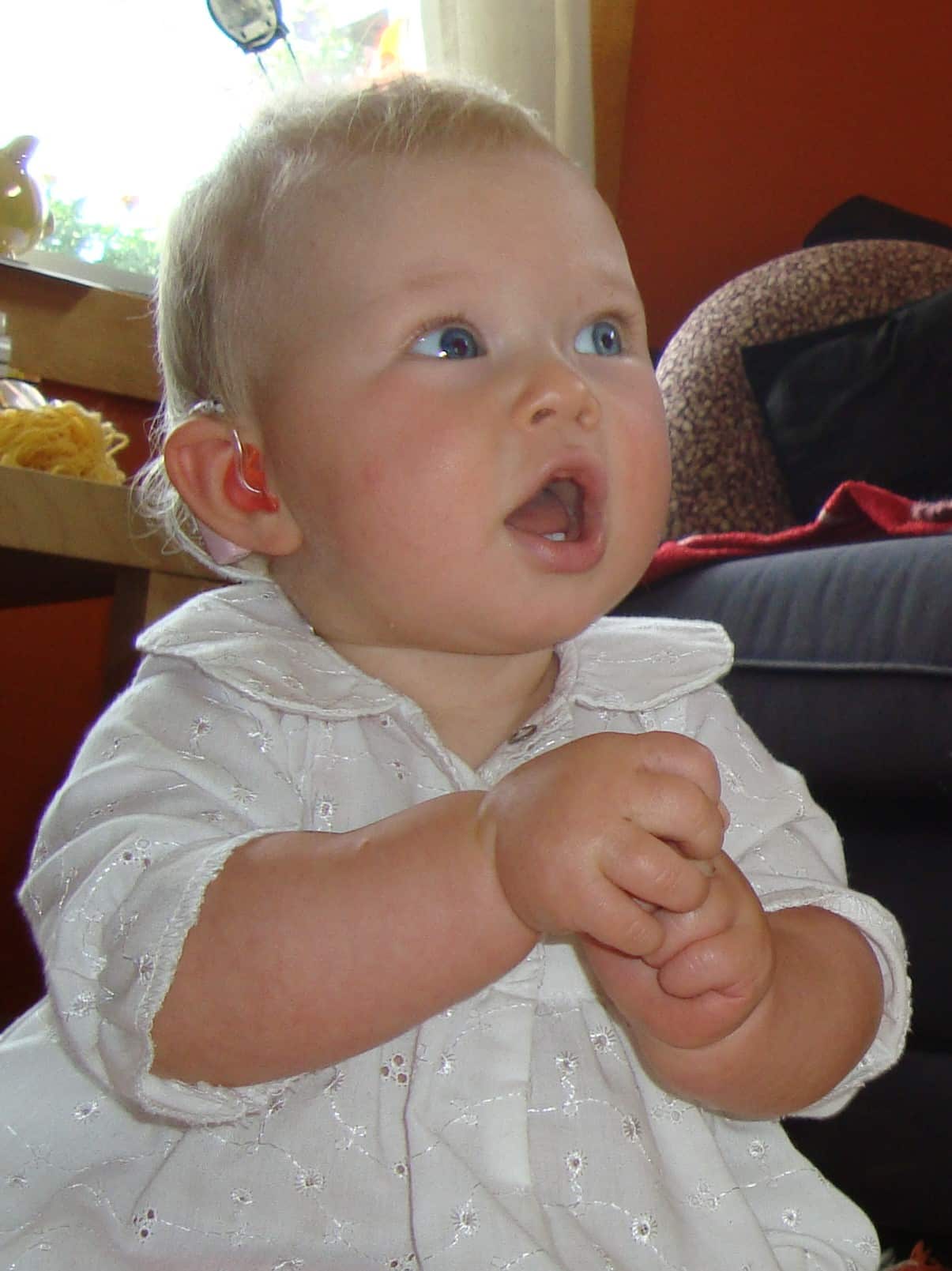
As a baby, Émilie was fitted with hearing aids for her severe to profound sensorineural hearing loss in both ears. Photo: Carolyn Duncan
At 11 months old, Émilie was referred to the Cochlear Implant team at BC Children’s Hospital to see if she would be a candidate for an implant for her right ear. After some disappointing delays due to middle ear infections, Émilie received a cochlear implant (CI) when she was 20 months old. Émilie subsequently had a second CI implanted, as her hearing aid was not providing adequate amplification.
By Kindergarten, Émilie understood and expressed English appropriately for her age. She continued to learn to speak French at home, and the family chose to enroll her in École Des Glaciers.
With the help of an involved and supportive family, the early intensive intervention certainly paid off.
Émilie is now entering Grade 9 and, in April, participated in the DHHproud–Showcase, a “contest designed for Deaf and Hard of Hearing youth to gain experience in public presentation, boost self-expression, gain self-assurance, and improve communication skills.” Émilie participated with ten other contestants in her category and received second place. She was among 80 Deaf or Hard of Hearing students competing in British Columbia.
Students competed live on a virtual platform and presented a 4-minute speech on the theme “What makes me proud to be Deaf or Hard of Hearing?” In her speech, Émilie described herself as a “sports person,” being able to do all sorts of activities like skiing, swimming, kayaking, and rock climbing and that she is “able to do all of these things even as a deaf person.”
She described her “Superpowers” — being able to listen to music through her implants (without anyone knowing) and being able to “take off her implants completely” when she is tired to help her restore energy. She cheekily mentioned her favourite part is being able to “mute” her brother.
She described learning sign language as her “base language” and the ability to now speak French and English fluently. Émilie spoke of the positive qualities of being deaf (Deaf Gain) and why she feels stronger because she is deaf. She experiences things better through touch and feel, often exploring with her hands while she is on the trail hiking. She finds she is more observant, noticing with her eyes what others might not. Subsequently, she’s able to read people’s body language and know what they might be feeling.
Émilie is proud to be deaf “because of her awesome superpowers that turn the world on and off,” her ability to do things differently, and the opportunity to learn three languages. Through early intervention and a supportive and active family, Émilie has achieved the power of Deaf Gain.
This article was written by Carolyn Duncan, Interior Health Speech-Language Pathologist.
What did you think of this story?
Your feedback after we publish a story helps ensure we're always improving our reporting to better serve you
Related Articles

Wastewater treatment plant upgrades set to future-proof facility for 2 decades
Plans to include Big Eddy residents and businesses into the updated facility still in the early stages, city director of engineering says.

Revelstoke granted $200,000 to rework development guidelines
Clarifying building requirements is key in speeding up development approvals, director of development services says.
More childcare spaces needed as families face estimated $35,000 income impact annually
Revelstoke Child Care Society still has over 160 families waitlisted as plans to expand into Okanagan College building take shape.