
Op/ed: It’s time to rethink Revelstoke streets
New thinking about how we use our streetscapes has created amazing public spaces in other cities. Why not in Revelstoke?
By Fraser Blyth
A city’s largest public space is held in its streets. For most people, streets are a place to drive and park. These two uses are held paramount above anything else. Recently many cities have begun to rethink their streets. By doing the math around streets, communities are realizing that they need to be more than just a place for cars. Think about all the other ways we as a community use Mackenzie Avenue. It’s where we stop to meet friends, wave hello, advertise, shop, run, bike, display art, and host public community events. Streets are dynamic places where most of our public city life happens.
Streets are one of the easiest public spaces to change. Cities have realized this and are acting on it. Cities can focus on one section of street, test how a change works and then implement it on other similar street types throughout the city.
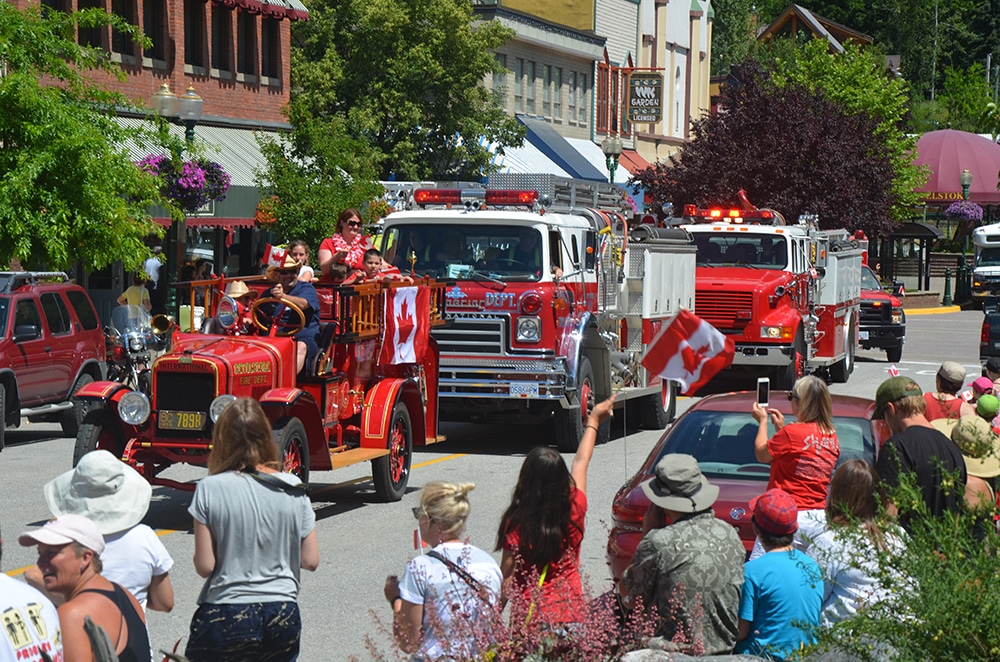
The traditional Canada Day Parade starts at the Revelstoke Courthouse at noon, up First Street then along Mackenzie Avenue to Queen Elizabeth Park. Photo: Aaron Orlando/Revelstoke Mountaineer
And cities are now doing this by testing different designs with low-cost methods. These methods are as simple as painting new street lines, removing parking spaces, building parklettes or installing planter box street trees. This allows cities an inexpensive test of these interventions before committing major funding to large-scale changes.
Typical street interventions include removing parking. While cities are often hesitant to remove parking, there are benefits. First, streets cost more to maintain than sidewalks or plaza space. That’s because cars produce more wear and tear than shoes and bike tires do. Second, parking is often underused. We build for a maximum number of spaces that are often never fully used. Think about all the on-street parking we have in Revelstoke. If you drive down Third Street you’ll notice that the on-street parking is rarely more than 10–15% full. Quick, name another city service that our taxes pay for where we’d be willing to accept 10–15% efficiency. This is one example of why rethinking streets can be beneficial for cities financial, social and environmental well-being.
One of the most famous examples of this is when New York City decided to close Broadway around Times Square. At the time it was one of the busiest streets in the entire world. The city closed the street using simple, inexpensive measures such as barricades, paint and makeshift street furniture. The plan was to keep the street closed for six months and test the outcomes.
Traffic and safety saw huge improvements. The big surprise was that this closure actually helped businesses. The realization that ‘cars don’t shop, people do’ was emphasized by the fact that retail sales rose 50%.
I think we all realize that Revelstoke is not New York City. But the lesson to be learned is that even a small city can test small changes to our public streets to see whether not they will be a benefit.
So with that in mind, here are some candidate streets in Revelstoke.
Grizzly Plaza

A larger than normal crowd at the nightly Revelstoke Street Fest in Grizzly Plaza is another sign of a booming 2016 summer tourism season in Revelstoke. Photo: Aaron Orlando/Revelstoke Mountaineer
This is an easy one. Because we’re already doing this for short periods of time for markets, events and music. It is the most versatile and dynamic public space in Revelstoke. So rather than just closing it for an hour or two at a time, why not try keeping it closed for an entire summer? There is no parking lost by doing this and it can be complimented with more street furniture, planter boxes and I would anticipate, more people.
The benefits of this closure would be to create a dedicated public space in the downtown useable 24 hours a day. It could also increase pedestrian traffic to surrounding businesses, meaning more potential customers. If successful, Revelstoke could look at a more permanent closure that would involve levelling the street and curb, removing the bollards and designing a more permanent plaza space. If this test is successful, similar designs could be considered in other areas of downtown.
Campbell Avenue
Campbell Avenue is a wide street with tons of potential. It’s also one of the prime gateways from Victoria into our downtown. It represents an opportunity to make downtown more attractive and inviting by making it more pedestrian friendly.
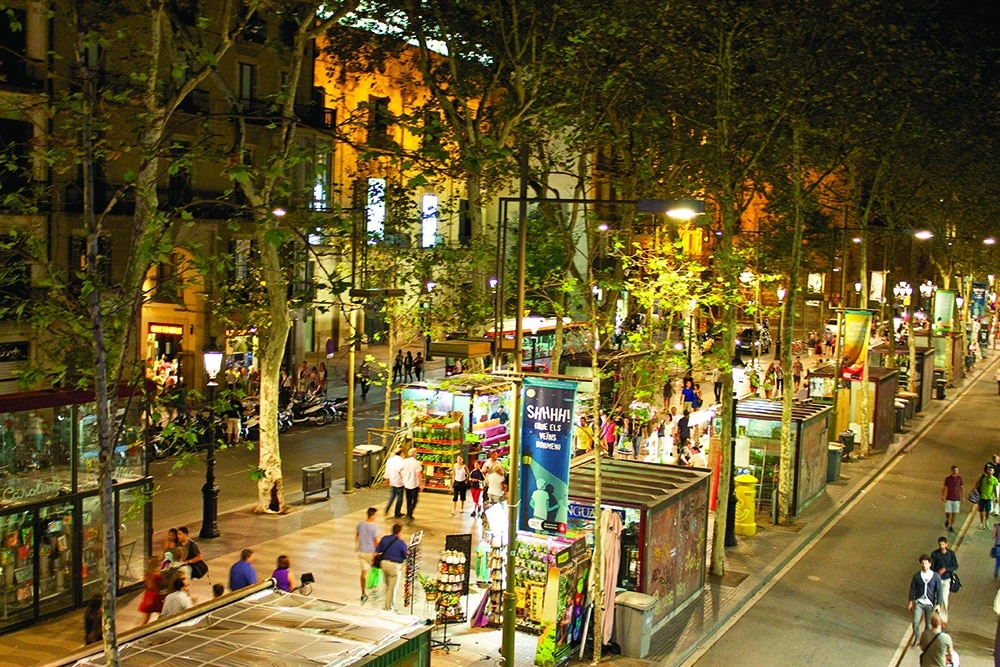
What I see in Campbell Ave. is its potential to function similarly to La Rambla in Barcelona. Vehicle lanes on either side, with places to park, with a large central median with trees that hosts numerous public and business activities. This street layout could be tested by changing the parking from angled to parallel along the median, and allowing surrounding businesses to use the median as patio space for cafes, restaurants, street retail, and other commercial uses.
The result is a minimal loss of parking and a huge expansion of potential commercial space. One of the potential benefits is the ability for a business to test its own ability to grow into a bigger space, without having to commit 100% before knowing whether or not it is a good idea. This can be good for growing businesses and create something unique to our area.
Third Street

Revelstoke’s distinctive old Mountain View School was built in 1914. Now plans are for it to be turned into a craft distillery among other uses. Photo: Emily Kemp/Revelstoke Mountaineer
The final example to look at is Third Street. With one of the largest right-of-ways in the city at 24 metres wide, it represents an opportunity to enhance the street for bikes, pedestrians, and cars. A simple test would be to use planter boxes or non-permanent bollards to create separated bike lanes. This may mean removing parking on one side of the street, but could be easily removed if it’s not effective.
I think we all understand that Third Street is the major bike route through town. So why not support it with dedicated cycling infrastructure? Not only would this show our commitment to cycling, but it would create something unique that would surely draw tourists and persuade them to return. We marvel at Amsterdam and Copenhagen for implementing bike routes. Third Street represents our best opportunity to create something similar.
The examples above are only three of many possibilities of utilizing Revelstoke’s streets in different ways. Not all will work, but by testing different options in a low cost way, we can start to build new streets that will be unique to Revelstoke, benefit businesses, pedestrians and cyclists, and encourage us all to walk/bike a little more.
This article first appeared in the October/November issue of the Revelstoke Mountaineer Magazine.
What did you think of this story?
Your feedback after we publish a story helps ensure we're always improving our reporting to better serve you
Related Articles
Wastewater treatment plant upgrades set to future-proof facility for 2 decades
Plans to include Big Eddy residents and businesses into the updated facility still in the early stages, city director of engineering says.
Revelstoke granted $200,000 to rework development guidelines
Clarifying building requirements is key in speeding up development approvals, director of development services says.

More childcare spaces needed as families face estimated $35,000 income impact annually
Revelstoke Child Care Society still has over 160 families waitlisted as plans to expand into Okanagan College building take shape.