
New Revelstoke councillor asks staff to present Jordan River protection plan options
Mayor Gary Sulz lone vote against councillor Tim Palmer’s request to expedite protection planning options for Jordan River Valley.

At its Mar. 23 meeting, new Revelstoke city councillor Tim Palmer gained support from all councillors in his request for staff to present options for protecting the Jordan River Valley and Westside Road area from industrial development at council’s next meeting. Mayor Gary Sulz was the lone vote in opposition.
The discussion was prompted by a letter from Wildsight Revelstoke, a local environmental organization formerly known as the North Columbia Environmental Society.

Revelstoke city councillor Tim Palmer. Photo: handout
The Wildsight letter appeared on the Mar. 23 council agenda. In it, Wildsight president Kent Christensen reminded council that the ENGO had expressed its concerns about proposed gravel pit development on Crown land within city limits in the area in June of 2019. “It is more than eighteen months later and nothing has been done to protect the area within city limits at Westside Road, which is designated environmentally sensitive,” he wrote.
Christensen noted a standing-room-only meeting in January of 2020 at the community centre, noting the crowd, “seemed unanimously opposed to these gravel pits and particularly to the Westside Road pit.”
Background: Read about the January 2020 public meeting about a proposed gravel pit in the Jordan River area here:
Revelstoke residents speak out against gravel pit proposed near Jordan River
Christensen noted that a company could file an application for a gravel pit permit at any time, and the city would have limited opposition to oppose it.
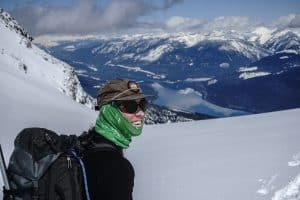
Wildsight Revelstoke president Kent Christensen. Photo: Ari Bruns
In response to the letter, Palmer presented a motion requesting staff report back at the next meeting with options for protecting the Jordan River and Westside Road area in question.
He noted that council had discussed the issue in the past and requested staff prepare reports, but there hadn’t been any tangible result.
“We have had a year,” Palmer said. “It’s time to get very, very concrete timelines on how we are going to accomplish this.”
Planning director says developing a plan takes time
City planning director Marianne Wade said developing plans that would lead to protection of the areas in question would take years. She said that many reports would have to be generated, outdated mapping would be have to be updated, expert technical consultants would have to be hired and any plans would have to integrated with other planning documents. Wade noted she had a limited budget for hiring consultants to do the work.
She said it would take at least a year to complete baseline studies that would determine the environmental value of the area.
She also noted that in planning sessions subsequent to last year’s January meeting, council had undertaken a planning prioritization process and had pushed the Jordan River protection plan into a lower priority category.
Palmer said that it was a priority for the community and that a report presenting options would be a first step. “This is a priority that council has identified a long time ago,” Palmer said. “Sometimes we need to have pressure and we need to move the law.” He said the city needed to represent the community’s interest on the property.
Palmer noted there were other options available to council, such as down-zoning the area to prevent development, adding he didn’t think protection required full integration with the Official Community Plan as proposed by the planning director.
The vote
At the vote, all councillors supported Palmer’s motion, meaning a report on options should be forthcoming for council at their next meeting on April 13. Mayor Gary Sulz, who argued for delaying the report to give staff more time, was the only vote against Palmer’s motion.
Analysis: Palmer brings experience to all-first-termers council, shaking things up
Tim Palmer was the former CAO with the City of Revelstoke before leaving in 2015 after a mayor and council turnover. He worked in municipal government through his career and also worked as a municipal consultant in other communities before being elected to council in February. In addition, his by-election platform included commitments to local environmental causes.
His experience brings him knowledge of how the processes underlying city business work.
In contrast, all other councillors are first-term councillors, many with little prior involvement with the municipal government context, such as experience sitting on city committees before their election.
The municipal government framework is complex, with many layers of legal requirements needing to be laid to achieve even modest community goals. Simply put, pushing something over the fence is harder than it looks. Within this context, inexperienced council members rely on staff to achieve their goals, presenting a vision of what they’d like to see, then asking staff to make it happen.
However, with many priorities competing for staff time and resources, it’s hard for staff to be everything to everyone. If council’s priority doesn’t sync with the processes of the planning department, staff can simply put it at the bottom of the pile in their inbox, delaying it for months, years or forever.
Without the benefit of a detailed understanding of the complex processes involved in crafting plans, councillors’ political goals can easily be sidelined.
In fairness, in this case the planning director argued that focusing on the bigger planning picture would have a better result than breaking off this individual project, which from a planning perspective would mean approaching it out of sequence of overarching planning processes. Certainly, reacting to each councillor’s whims isn’t a good way to do planning; however, not responding to democratic will of residents on issues important to them is a problem too. The challenge is striking the right balance.
There have been numerous public controversies over gravel pits in the Westside Road area over the past decade in Revelstoke, but a resolution to the serial controversies has been illusive.
In his election platform, Palmer emphasized action and results. Palmer came prepared with a motion, achieved full council support and put a deadline on it, setting up an interesting discussion topic for the April 13 meeting.
Watch the debate
Want more detail? Watch the debate from the Mar. 23 council meeting here. The video is cued to the start of the discussion over the Jordan River/Westside Road protection discussion.
What did you think of this story?
Your feedback after we publish a story helps ensure we're always improving our reporting to better serve you
Related Articles
Wastewater treatment plant upgrades set to future-proof facility for 2 decades
Plans to include Big Eddy residents and businesses into the updated facility still in the early stages, city director of engineering says.
Revelstoke granted $200,000 to rework development guidelines
Clarifying building requirements is key in speeding up development approvals, director of development services says.
More childcare spaces needed as families face estimated $35,000 income impact annually
Revelstoke Child Care Society still has over 160 families waitlisted as plans to expand into Okanagan College building take shape.