
It was a bluebird day, then all of a sudden …
Getting strained through a tree and earning a bloody compound fracture was actually the less of two evils in this ski touring story gone wrong

By Madeleine Martin-Preney
Editor’s note: The snow season’s here, and that means the avalanche season has started too. The Revelstoke Mountaineer reached out to the Revelstoke-based Avalanche Canada for a personal story about an avalanche incident that came with an illuminating message to share. Here’s Revelstoke-based skier and guide Madeleine Martin-Preney sharing her story about an incident while touring near the Empire Cabin near Kaslo, B.C.
It was a bluebird day in 2013 near the Empire Cabin. As a group of nine people we were spread out — a few of us faster at the front, others taking pictures and chatting a bit behind. Along the ridge crest I decided to drop down to a small copse of trees where it seemed reasonable to access the slope we wanted. I de-skinned quickly, wanting to get moving as we had a big day ahead of us and the sun would start affecting the other slopes we wanted to get to. As the rest of the group was still arriving at the transition spot, I turned to my friend:
“Hey, I’m going to start down. There is my re-group point, don’t send the next person until I get there, OK?”
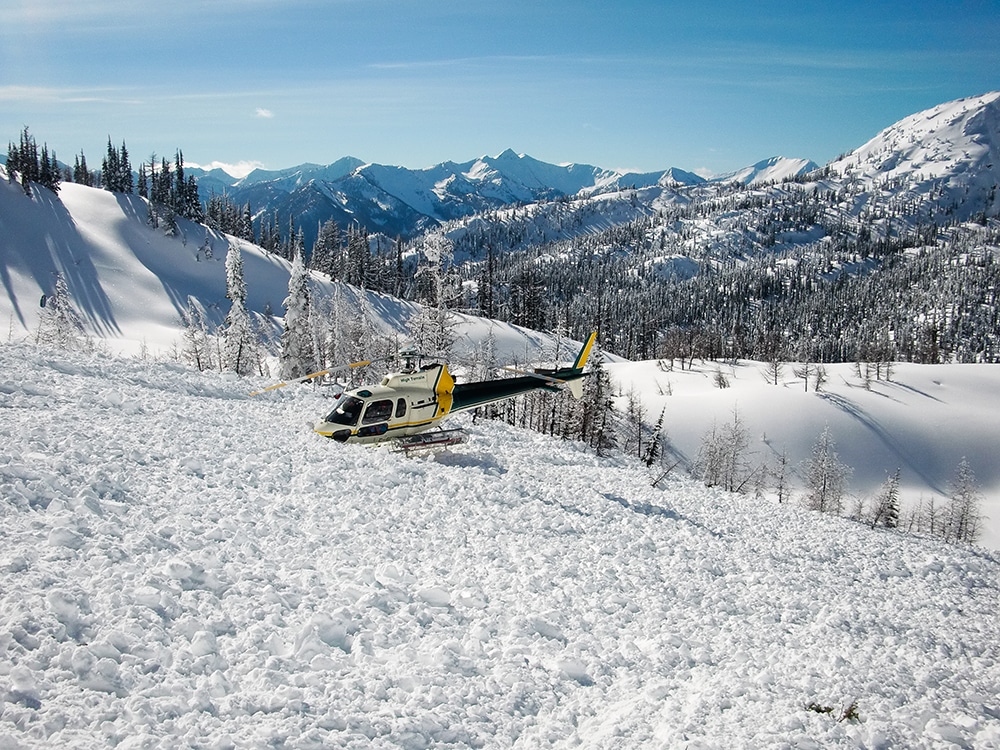
Images in the aftermath of the incident. Photos contributed by Madeleine Martin-Preney
“Ok sounds good!”
I started skiing down, feeling the familiar anxiety and excitement of being the first one on a new slope, unconsciously holding my breath.
I looked up behind me in time to see a crack shooting across the slope about 15 metres above me. In that instant I knew it had all gone wrong. I looked down the slope, remembering what I had told my Avalanche Skills Training 1 (AST) students all those times: “If you’re caught in an avalanche, try to ski out of it. If you can’t, ditch all your gear and start swimming – fight for your life!”
Except that for me, that felt impossible. I couldn’t ski out; I was stuck in the moving snow. I didn’t even have time to try and ditch my gear before I was crushed against a huge larch tree. Everything went dark and grey as I felt the washing machine effect of being inside the avalanche.
I could feel my body hitting trees as I ragdolled down the slope. I kept waiting for the final impact that would make it all stop.
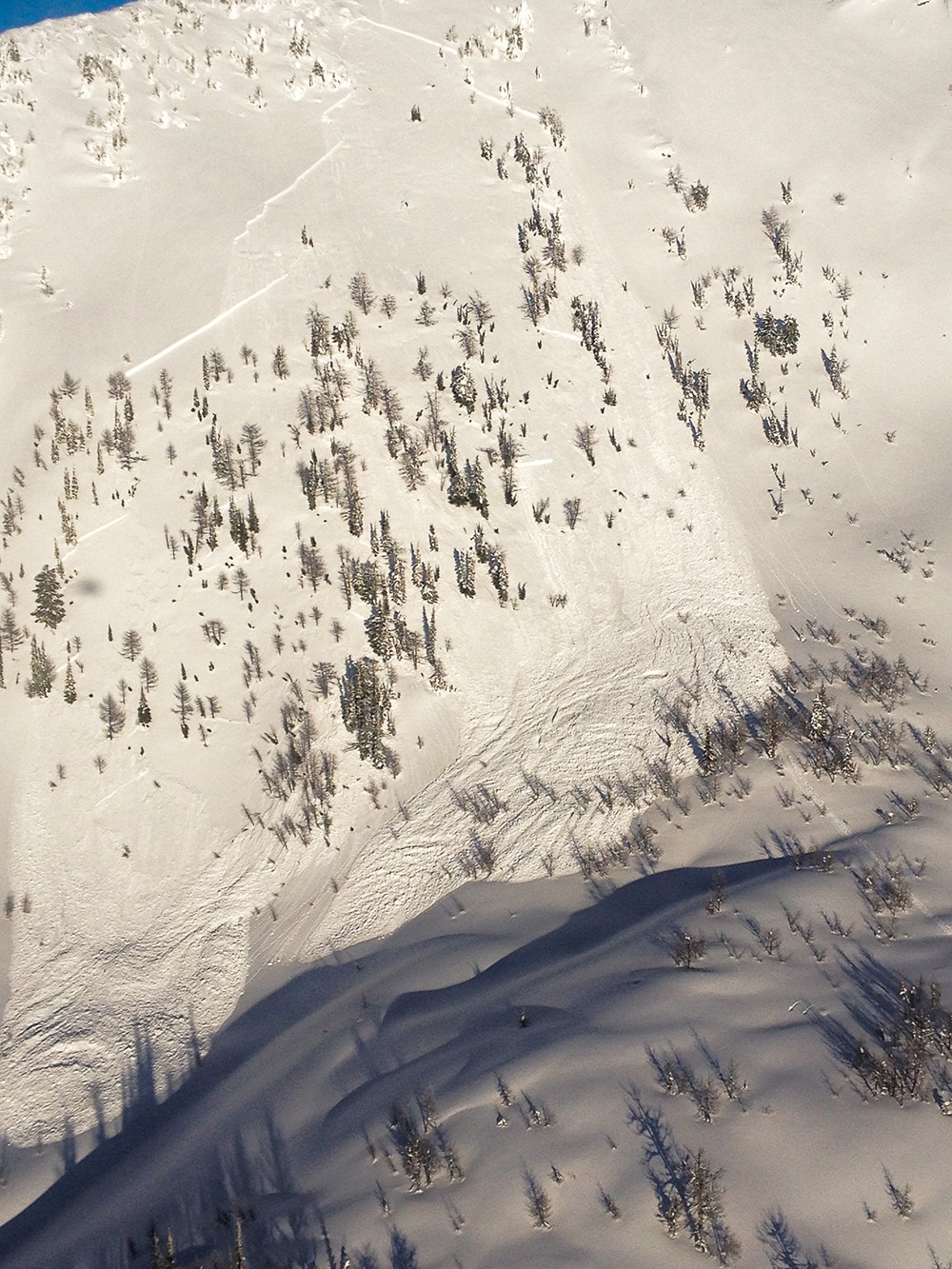
Images in the aftermath of the incident. Photos contributed by Madeleine Martin-Preney
‘If I am still alive when the snow stops moving, I have to try and make myself an airway,’ I thought.
Suddenly, instead of me moving with the snow I felt it pushing against me. Then stillness. Quiet.
I tried to lift my head. My eyes caught the faint movement of a small branch glistening in the sunlight against a bright blue sky. A huge wave of relief washed over me.
‘I’m not buried. I am still alive, I’m going to be OK,’ I thought.
I tried to sit up, realizing I was wrapped around a tree. That is what saved me from being buried under two to five metres of debris farther downslope. Looking down at my feet, I noticed one was at an odd angle. Reaching down I started lifting up my pant leg until I saw blood. I quickly put it back down, not wanting to know what was underneath, yet.
I started yelling, screaming as loud as I could for my friends, not knowing if they were all OK above the fracture line, or if they had also been caught and swept away.
Looking back
This event, as with many avalanche incidents involving people, was not the result of one really bad decision. It was the cumulative effect of several smaller decisions and a lack of awareness to the subtle changes in conditions – both internal and external.
Our group was not inexperienced. Many of us had several years of backcountry skiing experience and some bigger expeditions under our belts. A few had taken the Avalanche Operations Level 1 course, and all of us had first aid training. We had discussed conditions and investigated the snowpack in the slopes around the cabin. Avalanche danger for the region we were in had been recently downgraded from ‘considerable’ to ‘moderate’. We all felt fairly confident that we had done our research and investigated what we could. I had been given somewhat of an ‘expert halo’ as the one person who had been to the area before, even though it was only for an afternoon. I didn’t want to feel as though people were relying on me to make decisions, but I failed to verbalize that and create more discussion about the decision making as a group. Instead I internalized my unease and just went with it. This led to a situation in which others were not as likely to voice their concerns and observations, and perhaps that could have made a difference in the decisions and outcomes of that day. We will never know.
The ability to be aware of the subtle changes in conditions, both internal and external is essential. This skill builds over time with vast amounts of conscious experience and reflection. We were fortunate that this incident could become a part of building our experience instead of a tragedy.
***
If you’re new to the Revelstoke area and plan to seek powder this winter — even just a little bit on the other side of the ropes — be sure to check out www.avalanche.ca for a wealth of avalanche information and resources.
***
This story first appeared in the December issue of Revelstoke Mountaineer Magazine.
What did you think of this story?
Your feedback after we publish a story helps ensure we're always improving our reporting to better serve you
Related Articles
Wastewater treatment plant upgrades set to future-proof facility for 2 decades
Plans to include Big Eddy residents and businesses into the updated facility still in the early stages, city director of engineering says.
Revelstoke granted $200,000 to rework development guidelines
Clarifying building requirements is key in speeding up development approvals, director of development services says.
More childcare spaces needed as families face estimated $35,000 income impact annually
Revelstoke Child Care Society still has over 160 families waitlisted as plans to expand into Okanagan College building take shape.