
Compassion in the time of COVID-19
We spoke with Revelstoke therapists to explore how building emotional resilience can help us navigate through difficult times
This story first appeared in print in the Winter 2020 issue of Revelstoke Mountaineer Magazine. Read the e-edition here:
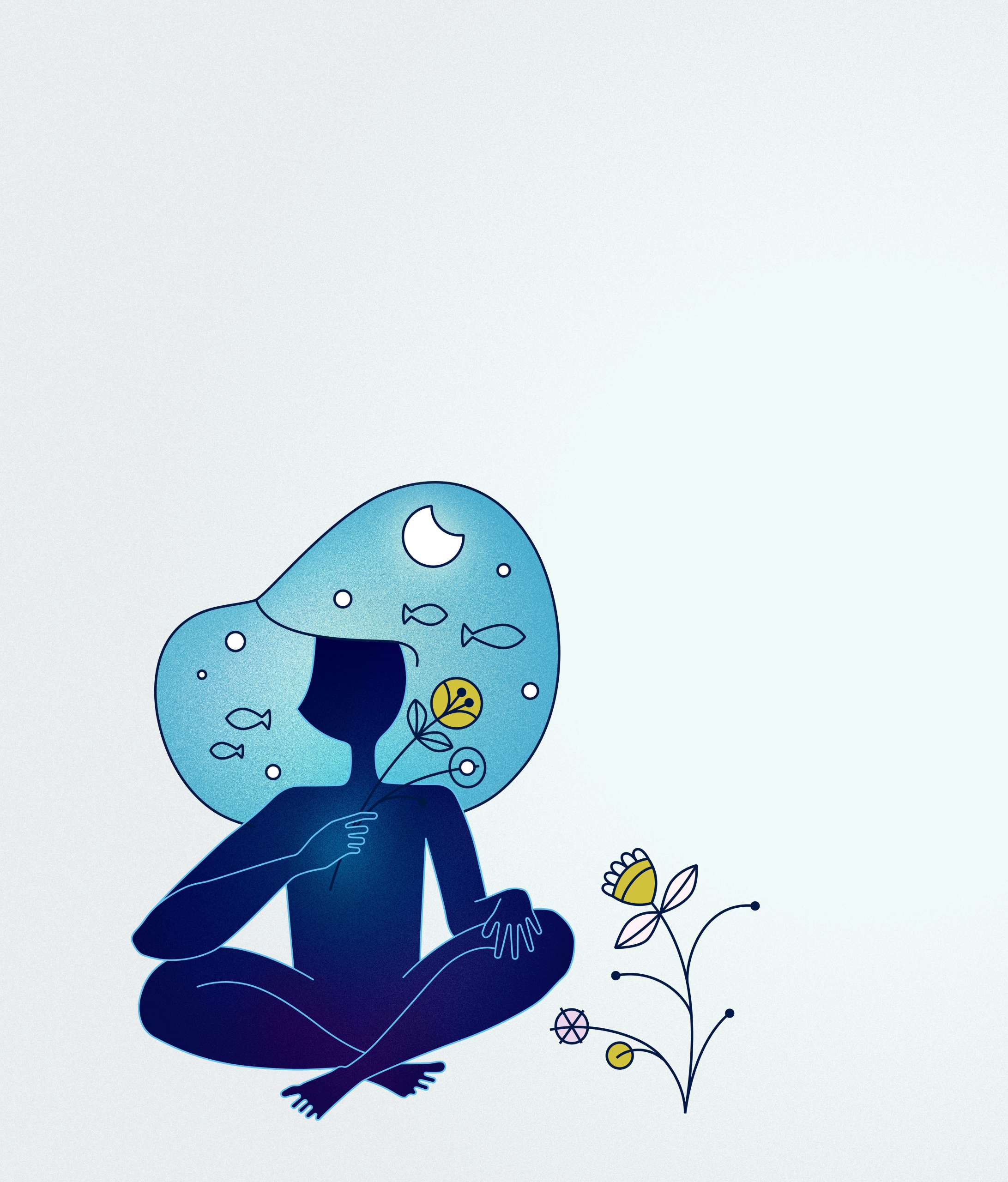
Illustrations by Sonia Garcia/Revelstoke Mountaineer Magazine
In university I had a roommate who kept a huge collection of stuffed animals — something I thought a bit strange for a woman in her early 20s. That was until I came home after a particularly difficult day that had left me feeling stressed, angry and absolutely defeated.
“I know what you need to do,” my roommate said. She proceeded to drag me into her room, where she pulled every single one of her stuffed animals out of the closet and onto her bed.
“Throw them,” she said, pointing at the lop-sided pyramid of stuffed toys.
“What!?”
“Just throw them,” she said. “Swearing helps too.”
So, I did. I threw every single one of those stuffed animals against the wall while yelling out strings of obscenities.
It felt … fantastic.
I can’t remember why I felt so awful that day, but I do recall feeling much better after the last stuffed animal hit the wall and then quietly slumped onto the floor with all the others.
Fast forward 20 years and we’re smack dab in the midst of the COVID-19 lockdown. I’ve just finished talking with a friend over messenger. We’d been discussing the current state of affairs and eventually our conversation made its way to COVID-19-related financial aid programs. At that time both the provincial and federal governments had yet to announce any assistance for people with disabilities (many of whom, myself included, already live on a fixed income that’s far below the poverty line). Since I happen to fit into that exact category, I voiced my frustrations over this.
“Yeah, but nothing’s really changed for you,” my friend wrote.
I started to type out a lengthy reply addressing the ways all the changes and restrictions caused by the novel coronavirus were impacting people with disabilities, myself included. The thing is I don’t like conflict. So, I deleted my message, replacing it with “Yeah, I guess that’s true,” and hit send.
The conversation ended soon after, but I found myself filled with frustration. My friend, who usually responds to my venting with compassion and understanding, had completely dismissed my feelings. Unable to let go of my anger I found myself wandering around the house picking up any soft item I could find. I piled them on the couch and began to fling them at an empty wall, strings of obscenities flowing from my lips.
Afterwards, I felt better, but it got me thinking: what is it about the current situation that has so many people lashing out at each other and responding with negativity and judgement, rather than positivity, compassion and kindness?
Our culture is obsessed with the idea of perpetual happiness and positivity. There’s multitudes of magazine articles, books and podcasts imploring us to ‘manifest happiness,’ or ‘discover the power of positivity.’ So why is it, then, that so many people struggle to stay positive, especially in the face of adversity? And what was it about the current COVID-19-impacted climate that seemed to make this even more difficult?
In order to better understand why people were struggling to maintain a sense of positivity in the face of a global pandemic, I reached out to three local experts: Registered Clinical Counsellors Jennifer Wright and Talia Camozzi, and Registered Psychologist Melanie Parkin.
Genetics, evolution at play in determining our ability to maintain a positive outlook
It turns out there’s a multitude of factors when it comes to determining why some people are more positive than others. Camozzi points out genetic predisposition and the influences of our childhood play a large role in how we see the world as adults.
“This continues into adulthood as trauma, tragedy, health, relationships, employment and affluence all play a role in how we see the world,” she says. “As life gets harder and more challenging, seeing the world positively becomes more challenging.”
Evolution is also at play here as our threat system evolved to keep us alive. Parkin says from an evolutionary perspective, it’s much more important for us to attend to threats in our environment.
“The example that’s often given is if you are living hundreds of thousands of years ago, you’re going to survive and pass your genes along if you are more hard-wired to notice the wild animal that’s going to eat you than if you are wired to notice a beautiful sunset and appreciate that,” says Parkin. “So, from an evolutionary perspective it’s just natural that our first instinct is going to go to threat and negativity.”
In other words, maintaining a positive outlook is something that takes practice. For people who have endured difficult circumstances such as trauma, this journey for positivity can seem even more burdensome. There is also a risk that delving into a desire to maintain a positive outlook can cause more harms — particularly for individuals who have yet to work through any traumatic events they may have experienced.
“I think we have to be careful how we use positivity because our culture is largely avoidant and consequently ‘positivity’ is often used to avoid processing difficult emotions,” says Wright. “The big lie we tell ourselves is that avoidance is less painful than processing difficult emotions and that undesirable emotions are bad.”
Wright points to statistics that show more than 70 per cent of the Canadian population has experienced at least one traumatic event in their lifetime. That number goes up among marginalized populations. Science now also shows that trauma changes the brain structurally, neurochemically and neuro-electrically.

Jennifer Wright, Registered Clinical Counsellor. Photo: Jennifer Wright
“Survivors of trauma, especially survivors of developmental trauma can be masters at masking their internal experience and often we assume that trauma always looks like dysregulated behaviour when it can look like many other things: poverty, incarceration, homelessness, substance abuse, hyperactivity, over-functioning, relationship failure, poor boundaries and much more,” says Wright.
“Part of developing a positive mindset is trusting oneself and knowing the difference between fear and intuition. This understanding gets very distorted for survivors of trauma that can fracture their sense of self.”
Viewing the pandemic through a trauma lens
So, what does all this have to do with trying to maintain a sense of positivity during a global pandemic?
For Wright, the pandemic meets all of the criteria for trauma. The result being our stress response systems are more easily triggered, making attempts at practicing positivity dependent on variables that “seem like a lottery system.”
On top of being traumatic, COVID-19 — and all of the restrictions, including a decrease in in-person social interactions — has led to many people feeling compelled to undermine how others might be struggling. Parkin notes when people feel resources are scarce it can fuel competitive and judgmental ways of thinking; it’s easier to offer generosity when it seems our own skies are filled with sunshine.
“Right now, the hatches are sort of battened down and people are not in a charitable mood. People are feeling brittle, like, ‘I can’t afford to be compassionate to this group, so I’m going to view it in this way to make it a little easier for me.’”
At its root, it’s a way of simplifying through stereotyping and prejudice, says Wright. “When we feel powerless to change another’s fate, we often reject and devalue them instead of responding with compassion and sympathy. Focusing on our own hardships can be a way to avoid the discomfort of feeling powerless to help others pain.”
Thinking back to the conversation I had with my friend, I can’t help but wonder if his inability to offer compassion towards my situation was in some way related to COVID-19-related hardships he was experiencing but felt unable to share with me.
Focus on compassion, rather than seeking out positivity
I was met with some apprehension when I began seeking professional input for this story. It seems the current trend towards pushing the power of positivity isn’t exactly popular with therapists, who are often supporting people who have spent time struggling in their attempts to overcome trauma and difficult life circumstances by burying themselves in the pursuit of happiness.
“For me, I sometimes get my hackles up with the whole positivity movement, even though I do understand, especially culturally, why that’s really important,” says Parkin. “I think working as a therapist […] we can help people accept all that is and that includes everything that is really hard, as well as the fact the sun keeps rising in the morning, that there’s beauty around us and from there we can choose where we focus our attention. But when positivity starts to feel like, ‘Nope, let’s just push all the bad stuff over there,’ then it starts to feel a bit like denial in a way, which is not what I think people intend to do.”
Having self-awareness of your own difficulties — and knowing you won’t fall apart if another person shares their own pain — can allow you to find compassion when others share their own struggles, says Parkin.
The reality is, we will all face storms and looking at things positively is not always a mental stretch that will work, says Camozzi.
“It can also sometimes be harmful to have positivity suggested as a way to get through the storm. Sometimes a better way through difficult times is to lean into your own strength and remember that you’ve been through other difficult times,” she says.

Talia Camozzi, Registered Clinical Counsellor. Photo: Talia Camozzi
The work of therapists often entails helping people notice the ways they are working hard to protect themselves. This can include depression, anger, anxiety, frustration or being overly self-critical.
“Learning how to respond to distress in the body and the mind involves introspection, compassionate observation, curiosity and a willingness to sit with the discomfort,” says Wright.
Through emotional resilience, we can learn ways to calm ourselves after experiencing negative or distressing emotions. I asked Parkin, Wright and Camozzi to share ways people can build emotional resilience and practice self-soothing during times of distress. Based on their input, here are 10 ways to start building emotional resilience and be more compassionate towards yourself and others:

Illustration by Sonia Garcia/Revelstoke Mountaineer Magazine
1. Spend time outdoors
An easy way to begin building up emotional resilience is to spend time outside. Parkin says even spending 15 or 20 minutes in a forested area can have a profound impact on our ability to see the world through a more positive light.
2. Move your body
For some people, it may be easier to build a positive mindset through seemingly unrelated behaviours aimed at calming the nervous system, says Wright. Examples of this include practicing yoga, playing tennis, throwing a Frisbee with friends, singing alone or in a choir, listening to low tone music and even volunteering.
“When the body feels safe, it is easier to expand our focus to allow a positive mindset.”
3. Look for the positives
One of the simplest ways to shift from a pessimistic world view is to begin retraining your brain to look for positive moments.
“Cultivating attention to the more positive aspects of life and engaging in that practice of ‘OK, there’s this happening that’s kind of negative, but what else can I notice in my environment that might give me a more positive lens on it, even if they’re small things compared to a big, negative struggle,” Parkin says.
A simple way to practice this is to go for a walk and look for things you find positive along the way, says Camozzi.
4. Journal
Many people keep a gratitude journal, and with good reason, said Camozzi: “It has been shown that people who have a practice of gratitude live more fulfilling lives.” However, both Camozzi and Parkin point out the idea of a gratitude journal doesn’t resonate with everyone, and that’s OK.
“I think journaling can be a really helpful thing, but not necessarily just gratitude. I think that can be a really powerful thing, but it might be particularly difficult right now because things are hard and we might not be feeling the best about the world or about people,” says Parkin.
Journaling can also be used as a space to acknowledge your feelings. If you’re experiencing rage or anger, Wright recommends moving your body until the physical feeling of anger has calmed. Afterwards, it can be helpful to write your feelings down.
“You don’t need to edit or be grammatically correct or politically correct, no one is going to read it. It’s just for you.”
5. Focus on your breath
According to Camozzi, focusing on your breathing is a simple self-soothing technique that may work for some people.
“You’ll notice I didn’t necessarily say deep breathing. Sometimes during stressful situations, we stop breathing enough and we need to take some time simply to get our breathing back to coming in and out smoothly,” notes Camozzi.
One way to do this is to think of your breathing like a box. Here’s how:
When you inhale, imagine drawing a vertical line going upwards for three seconds.
Hold that breath for three seconds and imagine the line going horizontal across the top of the box.
Exhale for three seconds and imagine the line going down.
Hold for three second and imagine the line connecting to your starting point.
6. Connect with friends and family
Connecting with people who love and care about you can be helpful in working through emotions. Talking to someone you trust about what’s going on can help process the negative experience more efficiently than attempting it on your own.
“Being with loved ones, being with people that you know, whether it’s talking with them or just being in [their] presence, that there’s a mutual care is something that can sooth us pretty quickly,” says Parkin.
One word of caution, however, is to be mindful of who you choose to share with.
“Not all connections are going to be safe ones for talking about negative experiences with,” says Camozzi.
With current physical distancing guidelines in place, it’s also important to acknowledge some people may struggle with virtual-based visits.
In person visits are the preferable option but may not always be possible with current physical distancing guidelines. While virtual visits are useful, it’s important to acknowledge some people may experience distress or fatigue using technology to communicate, says Wright.
“It may feel cold, it may not feel intuitive, time delays in feedback can create stress. If this happens, it may be helpful to communicate that with those you are talking to, break the communication into small chunks of time, and utilize an activity that helps you relax before or after.”
7. Re-frame your thinking
Dialectical thinking refers to an ability to consider that different viewpoints can co-exist with one another.
“To avoid appearing inconsistent, we will express attitudes that match our behaviour, even if those attitudes are not true to our internal dialogue,” says Wright. “Learning how to practice dialectical thinking is a valuable place to begin. For example, ‘I prefer a clean house,’ and, ‘I don’t want to clean my house,’ can both be true, even though they appear contradictory. We begin to exercise distress tolerance when we engage in dialectical thinking.”
8. Be gentle with yourself
The journey towards building emotional resilience and bringing more self-compassion into your life won’t always come easy. Parkin cautions it’s important to be aware if your desire to seek out positivity in your life is leading to more negativity through self-criticism.
“If the message you’re getting is ‘you’re in pain and you’re suffering and that’s because you’re not being positive enough,’ you feel an intense pressure to be positive and that tends to come in the form of self-criticism. So that very hunt for positivity means you are actually having more negative thoughts and more painful thoughts,” says Parkin. “If right now [trying to be more positive] is leading to more suffering and self-criticism then that’s not working, and then we’re looking more under the lens of compassion. Can you have compassion for the suffering you are having right now?”
9. Don’t avoid processing difficult experiences and emotions
Sometimes, in our desire to re-frame a tragedy in a more positive light, we miss out on the importance of processing those difficult experiences.
“The risk in skipping over difficult situations is that your nervous system will remember it and that situation will continue to influence you — sometimes outside your regular awareness. The main point of switching from a pessimistic worldview to a more positive worldview is that it is a conscious effort that involves some effort on your part,” says Camozzi.
For Wright, growing a more positive outlook begins with learning to sit in non-judgement with the parts of ourselves that may not feel, think or behave in the most productive ways. Learning to process negative emotions and experiences is where we build emotional resilience.
“I encourage my patients to be polite with their thoughts and feelings and to spend time just sitting with them, validating them and accepting them,” says Wright. “Thoughts and feelings are parts of us that through time have developed in an effort to protect us and even though these parts can say, think, feel, and do some very unkind things, their sole goal is to protect you in some way.”
10. It’s totally OK to seek out therapy
Sometimes all the nature walks, journaling and connections aren’t enough and we find ourselves still feeling numb and unable to let go of negative thoughts and emotions. When that happens, you may want to consider seeking out a therapist who can help you to process those difficult pieces.
“Some people really struggle with the idea of compassion, particularly self-compassion and that would be when therapy would be recommended,” says Parkin.
Revelstoke has therapists available in both private and public practice. If cost is a concern for you, there are free therapy options available. If you have extended medical benefits through your employer, you can also check to see if this will help cover some or all of the cost of counselling sessions.
You can find out more about counselling options available in Revelstoke by visiting revelstokelife.ca.
What did you think of this story?
Your feedback after we publish a story helps ensure we're always improving our reporting to better serve you
Related Articles

Wastewater treatment plant upgrades set to future-proof facility for 2 decades
Plans to include Big Eddy residents and businesses into the updated facility still in the early stages, city director of engineering says.

Revelstoke granted $200,000 to rework development guidelines
Clarifying building requirements is key in speeding up development approvals, director of development services says.

More childcare spaces needed as families face estimated $35,000 income impact annually
Revelstoke Child Care Society still has over 160 families waitlisted as plans to expand into Okanagan College building take shape.