
Celebrate the struggle for women’s suffrage in Revelstoke
Revelstoke gets ready to celebrate the centennial of the women’s suffrage movement in Canada.

By Cathy English, Curator, Revelstoke Museum & Archives
April 5, 2017 marks the 100th anniversary of women gaining the vote in British Columbia. This was the culmination of several years of campaigning by the women of the province. It was one more year before women were allowed to vote in federal elections.
Women’s voting rights were not achieved without a struggle. By 1911, women in the province were actively campaigning for the vote. The B.C. Political Equality League was established, with branches in many towns across the province. When it was organized, the editor of the Revelsoke Mail-Herald expressed doubt that Revelstoke women would respond to the call for action, as he believed that they, “do not take any working interest in either municipal, provincial, or federal politics.” He was to be proven wrong, as the movement soon gained traction here after provincial organizers came to speak several times in Revelstoke.
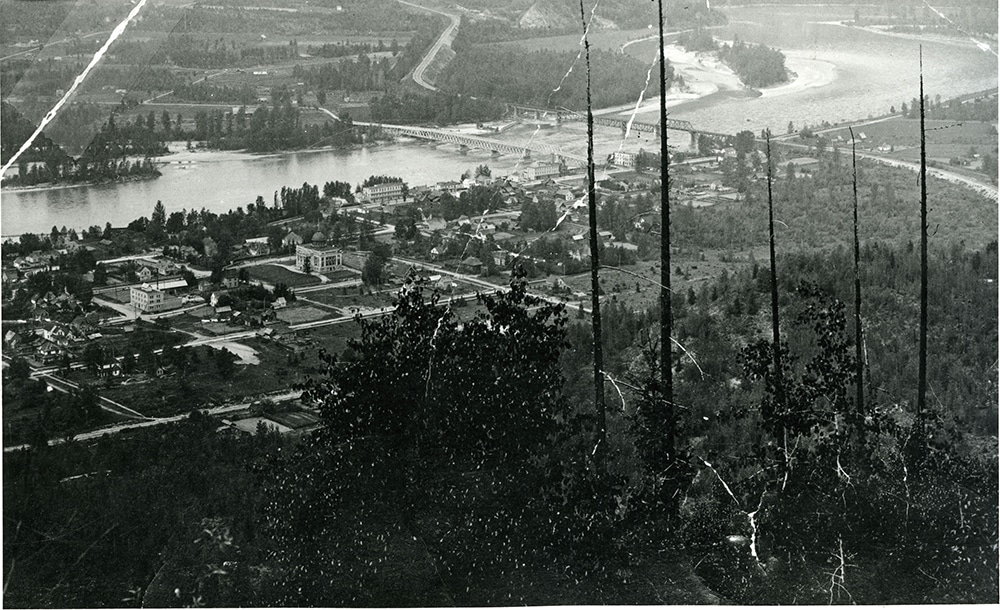
Panorama of the western end of town, circa 1915. Photo: Revelstoke Museum & Archives
The Revelstoke branch of the Political Equality League was formed in November 1912, with many prominent local women joining. Miss J. Hardie, secretary of the local branch, wrote a letter to the editor of the Revelstoke Mail-Herald in December of 1912, in which she outlined some of the legal inequalities which women dealt with at the time. She stated that a mother had no right of possession in her legitimate child and that the father had sole authority in the education and disposition of his child, although the mother was equally responsible for its maintenance. In the case of a deserted wife, the husband had the right to collect and use the earnings of their minor children, and in some cases, even his wife’s wages. A wife had no property rights: her husband could sell or give away land even if the wife’s money helped to buy it. These and other inequalities provided a major motivation for women to fight for the right to vote. They felt that until they had the power of the vote, these issues that directly affected them and their children would not be dealt with in the political sphere.
In early January, 1913, Revelstoke women canvassed the community getting signatures for a petition asking the legislature to grant women the right to vote. It was noted in the January 22, 1913 issue of the Revelstoke Mail-Herald that, “almost every one who was asked to sign did so, men as well as women, and hundreds of signatures testify to the popularity of the movement.” Provincially, the petition gained more than 10,000 signatures, but the bill for women’s suffrage was defeated 24 to 9 at the spring sitting of the Provincial Legislature.
Despite the evidence of community support for women’s suffrage, Ralph Scruton, the editor of the Mail-Herald wrote a scathing editorial against the movement in the November 30, 1912 issue of the paper. In part, he stated, “In the absolutely brutal struggle which must follow any organization of society based upon equality between the sexes, the finest traits of feminine character inevitably disappear as women cannot continue to possess all the privileges of their own sex, whilst greedily and mistakenly grasping for the cares and responsibilities shouldered by men.”
One of the early campaigners for women’s suffrage in B.C. was Florence Hall, the wife of Reverend William Lashley Hall, a Methodist minister. She was the first president of the Vancouver chapter of the Women’s Political Equality League, and later a provincial organizer. She made several trips to Revelstoke before coming here to live in 1913, when her husband was appointed as the Methodist minister. Once in Revelstoke, Florence Hall became active in the local branch of the equality league. She wrote an impassioned letter to the Mail-Herald on November 29, 1913. In part, it read, “A new spirit is seizing the western woman … Throughout the province, they are asking why? Why is woman’s legal status thus? Why is she a non-entity in the eyes of the law? Why has she no right to her own child? … A peaceable revolution is taking place at this juncture in the history of British Columbia, which is destined to bring a betterment in the condition of women generally. It may be that a reversal of the old regime is about to take place; but certain it is that evolutionary forces are at work that no man-made law can stop. One may as well blot out the blue of the sky, or drain the ocean dry, as to attempt to frustrate the onward march of women.”
After a long struggle, the question of women’s suffrage was put to the male voters in the provincial election in the fall of 1916. By that time, public opinion had turned, and the editor of the Revelstoke Review wrote on September 7, 1916, “every elector should vote for the Woman’s Suffrage Bill. Give your mothers, sisters, wives and sweethearts a vote at the next election.” The bill did pass, and was enacted into law the following April.
Revelstoke Museum and Archives will celebrate this historic anniversary on Saturday, May 6 with a “Suffragettes Tea.” Participants can enjoy their tea while being entertained by local actors who will portray the story of the suffrage movement in Revelstoke. Everyone is encouraged to dress in period costume, and prizes will be awarded for the best costumes.
What did you think of this story?
Your feedback after we publish a story helps ensure we're always improving our reporting to better serve you
Related Articles
Wastewater treatment plant upgrades set to future-proof facility for 2 decades
Plans to include Big Eddy residents and businesses into the updated facility still in the early stages, city director of engineering says.
Revelstoke granted $200,000 to rework development guidelines
Clarifying building requirements is key in speeding up development approvals, director of development services says.

More childcare spaces needed as families face estimated $35,000 income impact annually
Revelstoke Child Care Society still has over 160 families waitlisted as plans to expand into Okanagan College building take shape.