
Community advocates voice concerns over lack of illicit drug testing in Revelstoke
As the opioid crisis rages on, including four illicit drug toxicity deaths in Revelstoke in 2021, local harm reduction advocates are overcoming the lack of available drug testing by pushing community support.
As the opioid crisis rages on and urgent drug warnings spread across the Interior Health (IH) region, a visible gap in drug testing services is appearing in Revelstoke.
On Feb. 16, Interior Health (IH) issued a region-wide drug alert, warning of high concentrations of fentanyl and benzodiazepines found in illicit substances. In the warning, IH authorities urged people to “get your drugs checked — find locations at drugchecking.ca.”
However, there are no drug testing services within 100 kilometres of Revelstoke, this despite ongoing toxic drug fatalities in the community.
“There’s more and more drugs that are deadly. It’s not just opioids. There’s fentanyl mixed in with all sorts of things [illicit drugs],” explains Erin MacLachlan, co-director of community outreach and development at Community Connections. In August 2021, Community Connections became Revelstoke’s first non-profit registered harm reduction site.

File photo: Erin MacLachlan, co-director of Community Outreach and Development at Community Connections. Photo: Bailey Gingras-Hamilton
Despite noticing an increased interest in harm reduction within the Revelstoke community, MacLachlan acknowledges that some services fall short.
“Ultimately I [am] just promoting that all harm reduction activities and supplies are helpful, but Revelstoke definitely doesn’t have everything that we need.”
Differentiating harm reduction services
In response to the ongoing opioid crisis, many clinics and non-profit harm reduction providers across British Columbia began testing illicit substances.
Testing services range from take-home fentanyl test strips to more comprehensive mass spectrometer testing.
As a registered harm reduction site, Community Connections offers a wide array of harm reduction resources in a judgment-free environment. This includes naloxone kits, safer smoking and injection supplies, and counseling.
“The take-home naloxone kits are most often requested,” chimes MacLachlan, adding that “inhalation kits and injection kits” containing clean straws and needles come a close second.
However, Community Connections does not have the financial or physical capacity to offer drug testing.
“Right now our capacity allows us to [continue] what we’re doing. We got more funding to continue offering harm reduction,” MacLachlan explains, adding they prioritize remaining “accountable to [providing] a particular type of service ongoing.”
Visible gap in drug testing services around Revelstoke, despite data indicating higher overdose rates
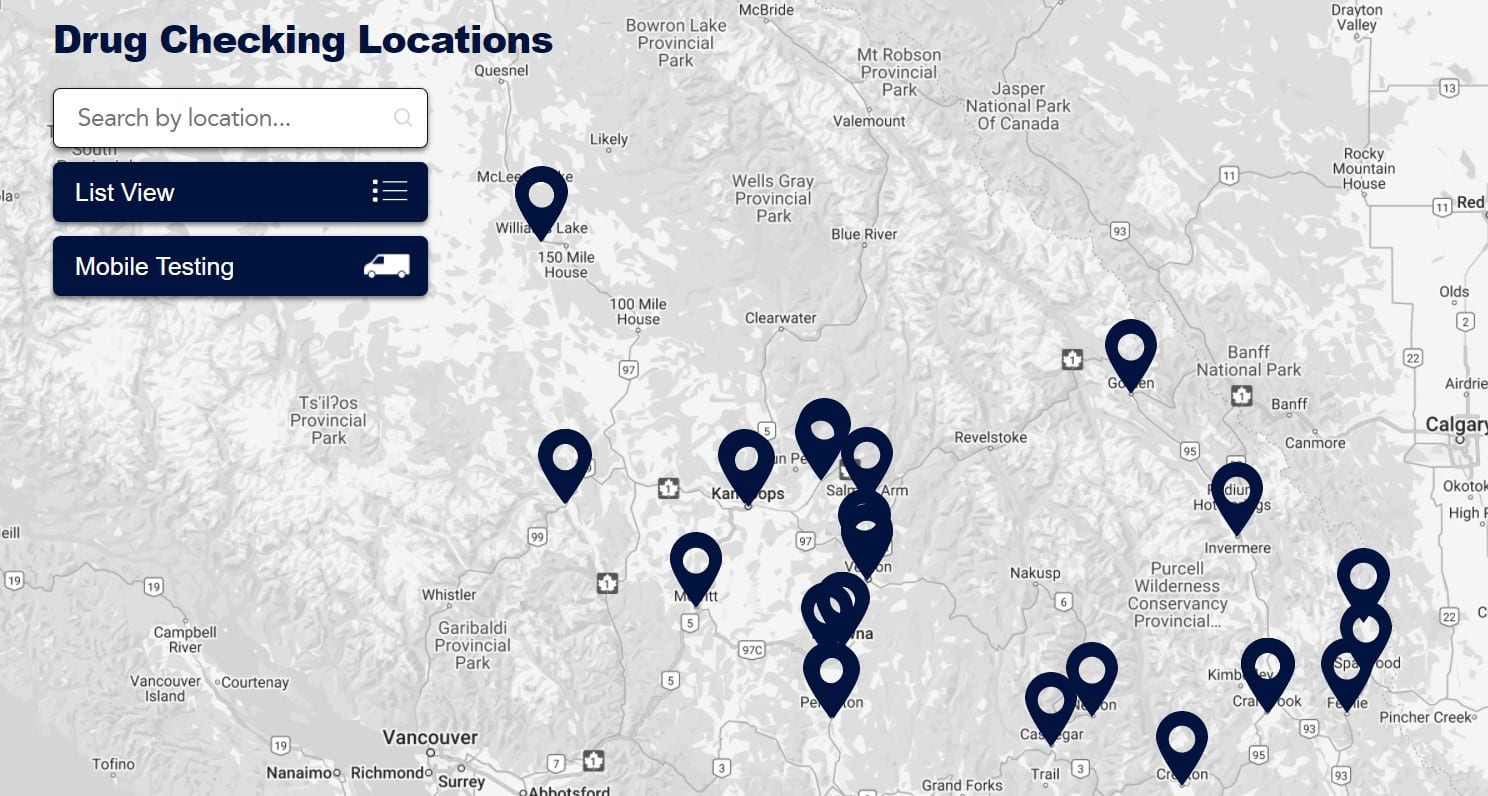
Looking at a map of drug checking services across the IH region, there is a gap in resources spreading from Revelstoke to Nakusp.
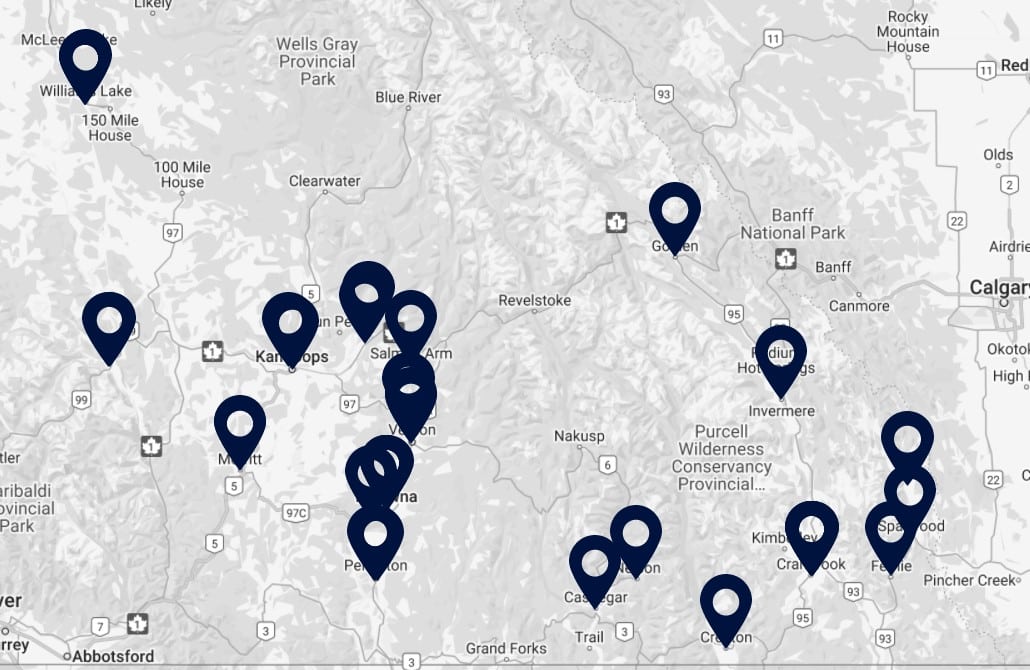
A close-up of the map provided by IH authorities indicates a visible gap in drug testing services around Revelstoke. Source: drugchecking.ca
In a report released Feb. 9, 2022, titled Illicit Drug Toxicity Deaths in B.C., the BC Coroners Service reported four deaths related to illicit drug toxicity in Revelstoke in 2021. This brings the town’s illicit drug toxicity death rate to 42.6 per 100,000 people.
There were also four deaths in Revelstoke during the previous calendar year, in 2020.
While BC Coroners Service warns that local “[death] rates may be difficult to interpret” due to “small numbers of deaths and population size,” they can serve as a comparison when looking at other townships that offer drug testing services.
Several towns, including fellow resort communities Golden, Fernie and Kimberley, offer take-home fentanyl test strips through East Kootenay Addiction Services Society, a program funded by IH. In 2021, all three of these communities had significantly lower overdose rates than Revelstoke; with Kimberley reporting two deaths, Golden reporting one death, and Fernie reporting zero.
However, take-home drug testing kits have notable limitations. According to MacLachlan, take-home drug testing kits are “not widely promoted because they’re really inaccurate.”
At-home drug testing kits require a fully-crushed sample of a substance. Even if a perfectly executed test indicates no fentanyl content, there is a risk that remaining untested contents could contain fentanyl, explains MacLachlan.
In response to questions from revelstokemountaineer.com, Interior Health provided a brief written statement in regards to the availability of drug testing in Revelstoke:
Interior Health is looking at options to expand drug checking services in Revelstoke and we encourage any agency interested in increasing access to drug testing in Revelstoke to reach out to us. Generally, this service is a partnership between Interior Health and community agencies.
Community support helps fill gaps in health services
Despite the shortage of drug testing services in Revelstoke, MacLachlan is hopeful that increased awareness around harm reduction will save lives across the drug-user spectrum.
“It’s not just for habitual drug users. It’s for anybody that might know somebody that’s a drug user,” MacLachlan explains, setting up a scenario that many affected by the opioid crisis unfortunately face.
“Say you’re at a party and there’s a bunch of people there … then someone starts using substances and they pass out and nobody knows what’s going on. If you have a naloxone kit and you’re able to help them before the ambulance gets there, that’s hopefully one less death related to substance use.”

File photo: The contents of a life-saving naloxone kit. Image: Toward the Heart.
That is why Community Connections is focusing on continuing the conversation around harm reduction and fighting the stigma that surrounds illegal substances. Beyond the alarming statistics used to portray the opioid crisis, there is a community fighting to save itself.
“We’re all substance users,” MacLachlan reminds, pointing to more socially acceptable vices like coffee and alcohol.
“Substance users themselves, when we have conversations, they talk about how they protect each other. People that are using substances are aware of the risks, and they’re doing their own type of harm reduction and planning in their groups,” MacLachlan elaborates.
“Those conversations are happening, and I find that element of harm reduction often gets overshadowed by the more medical or big scale support. But really, on a day-to-day basis, community members are looking out for each other, and there’s a ton of community members that are coming and asking questions about naloxone. Even though they’re not substance users.”
For more information about harm reduction resources, visit Community Connections during their drop-in hours. Up-to-date drop-in times are available on their website.
This story was initiated by revelstokemountaineer.com.
What did you think of this story?
Your feedback after we publish a story helps ensure we're always improving our reporting to better serve you
Related Articles
Wastewater treatment plant upgrades set to future-proof facility for 2 decades
Plans to include Big Eddy residents and businesses into the updated facility still in the early stages, city director of engineering says.

Revelstoke granted $200,000 to rework development guidelines
Clarifying building requirements is key in speeding up development approvals, director of development services says.
More childcare spaces needed as families face estimated $35,000 income impact annually
Revelstoke Child Care Society still has over 160 families waitlisted as plans to expand into Okanagan College building take shape.